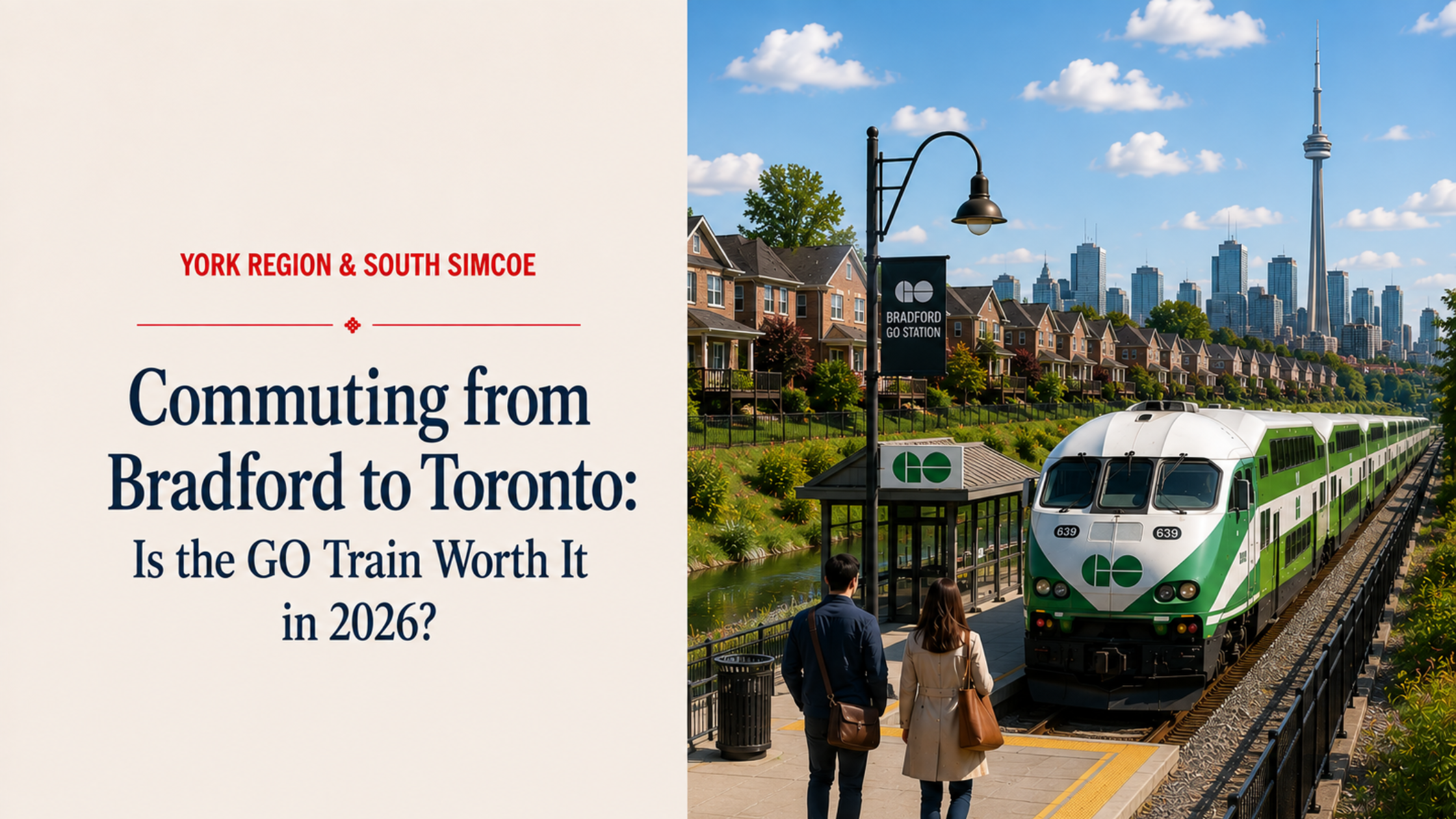
Commuting from Bradford to Toronto: Is the GO Train Worth It in 2026?
For a hybrid worker, the Bradford GO Train can be worth the longer trip if more space, a yard, or a lower entry price is more important than living closer to Toronto. For someone commuting to a downtown office five days a week, the time cost needs a more cautious review. The right decision depends on your actual office location, departure times, and what the same budget can buy closer to the city.
A Bradford-to-Toronto commute is a lifestyle trade-off. You are usually giving up time for space, but that trade can make sense when it is measured honestly rather than assumed from a map.
How Long Is the GO Train From Bradford to Union Station?
Most scheduled Bradford GO–Union trips are roughly 70 to 80 minutes station-to-station, depending on the departure. From many Bradford neighbourhoods, add roughly 5 to 15 minutes to reach the station, plus parking or drop-off and the final walk or connection from Union. For a downtown-office commute, 80 to 100 minutes each way is a more realistic planning range for many households.
Service frequency is lower than a subway or frequent urban rail service, and it varies by time of day and day of week. Before treating the route as a daily solution, use GO Transit’s trip planner to confirm the departures that match your actual office schedule and check the current Barrie-line schedules.
That does not automatically make Bradford a poor choice. It means the commute is best treated as a deliberate part of your weekly plan rather than a detail to sort out after you buy.
Is Driving From Bradford to Downtown Toronto Faster?
Not consistently. The Highway 400 route can be efficient outside peak periods, but a drive from Bradford to downtown Toronto is often about 50 to 70 minutes outside peak periods and can exceed 90 minutes in heavy traffic, poor weather, or construction. The practical answer also depends on where in Toronto you are going.
Driving can make more sense for work in Vaughan, the west side of Toronto, or job sites that are not close to Union Station. If you work near the Financial District, the train may feel less demanding because the travel time can be used for work, reading, or simply avoiding traffic.
Bradford GO Train vs. Driving: The Commute Reality
| Question | Bradford GO Train | Driving via Highway 400 |
|---|---|---|
| Core travel time | Roughly 70–80 minutes to Union, depending on departure | Often 50–70 minutes outside peak periods; longer in congestion |
| Door-to-door reality | Often 80–100 minutes once station access and the Toronto end are included | Highly variable; allow extra time for peak traffic, weather, parking, and your final destination |
| Best for | Financial District, Union Station, and hybrid work | Vaughan, west GTA, flexible hours, and job sites outside downtown |
| What is predictable | A scheduled ride once you are on the train | Route flexibility outside rush hour |
| Main trade-off | Long ride and schedule dependence | Traffic, fuel, parking, and less predictable arrival time |
Plain-language verdict: If you commute downtown two or three days a week, Bradford can be a reasonable choice. If you commute downtown five days a week, test the full route before making the housing trade-off.
What Does the Bradford Commute Cost Each Month?
The fare is not the only cost of choosing Bradford, but it needs to be part of the decision. Using an illustrative one-way fare range of $12 to $16, commuting downtown two days per week works out to roughly $190 to $255 per month over a four-week month, before applicable discounts. At three days per week, the illustrative range is about $285 to $385 per month.
These are planning illustrations, not quoted fares. Your actual cost depends on your trip, fare product, travel pattern, and eligibility for programs or discounts. Use GO Transit’s trip planner and fare information before budgeting. For eligible PRESTO transfers between GO and TTC, Ontario’s One Fare program can reduce the local-transit portion of the trip; confirm current eligibility and rules before relying on a specific amount.
The real comparison is not only transit cost versus fuel and parking. It is the combined monthly mix: the extra commuting cost in Bradford versus the additional purchase price, property taxes, and ongoing home costs a closer-in property may carry.
What Does the Bradford Commute Buy You?
Buyers do not choose Bradford because it has the shortest Toronto commute. They choose it because the housing trade-off can be meaningful.
At an approximately $850,000 budget, buyers may find more opportunities for a newer townhouse, semi-detached home, or selected detached-home options in Bradford than in comparable areas of Newmarket or Aurora. Availability varies substantially by property type, condition, lot, and month, so compare current listings before treating this as a guaranteed price gap.
For a grounded starting point, compare the July 2026 York Region and South Simcoe market update, the Moving to Bradford guide, and the Best Places for First-Time Buyers guide. The right question is not only, “How long is the commute?” It is also, “What does the extra commuting time give my household every day?”
Which Bradford Neighbourhoods Work Best for Commuters?
Grand Central is one of the strongest options for drivers because it is the Bradford neighbourhood closest to the Highway 400, Highway 88, and Line 5 access points. It is also a practical choice for buyers who want a newer master-planned community with townhouses, semis, and detached homes. Read the full Grand Central community guide.
Summerlyn Village can suit households who value established parks, schools, and a family-oriented feel while keeping reasonable access to Highway 400 and Bradford GO Station.
Central Bradford can work well for commuters who want to be closer to Bradford GO, Holland Street services, and older housing stock. The trade-off is an established-town feel rather than a new-subdivision setting.
Who Is the Bradford-to-Toronto Commute Best For?
Hybrid workers. If you work from home two or three days a week, a longer GO trip can be much easier to manage. This is the buyer profile for whom Bradford often makes the most sense.
Families choosing space over a shorter commute. If a yard, an extra bedroom, recreation space, or a lower purchase price matters more than being 15 to 20 minutes closer to Toronto, Bradford can be the practical answer.
People who work outside downtown Toronto. Bradford can also work well for people employed in Bradford, Newmarket, Vaughan, Barrie, Innisfil, Alliston, or along the Highway 400 corridor.
Who Should Think Twice Before Choosing Bradford?
Bradford may not be the right fit if you must be at a downtown Toronto office five days a week, have little tolerance for an 80 to 100-minute door-to-door commute, or want car-free urban living.
It may also be less suitable if your work schedule is highly unpredictable and regularly requires late-night downtown trips. In that case, a community with a shorter GO trip or more direct transit options may protect your time and energy better, even if the home costs more.
Bradford vs. Newmarket vs. East Gwillimbury for Toronto Commuters
| Community | GO and transit consideration | Highway access | Housing trade-off | Best fit |
|---|---|---|---|---|
| Bradford | Longer GO trip; confirm departure fit before choosing it as a daily routine | Highway 400 | More space and newer-home opportunities for the budget | Hybrid workers and families prioritizing value |
| Newmarket | Shorter potential rail trip for some schedules, but confirm your specific station and departure | Highway 404 / Yonge Street | Higher entry price with more urban amenities and services | Frequent downtown commuters and buyers who value services |
| East Gwillimbury | Service and trip length vary by station and village; confirm the live schedule | Direct Highway 404 access | More rural or new-build choices depending on village | Buyers working along the 404 corridor or using hybrid schedules |
For a broader comparison, start with the Bradford, East Gwillimbury, and Newmarket community guides, then compare the active homes that fit your exact budget and work pattern.
A Practical Test Before You Buy
Before you make an offer in Bradford, test the commute the way you would live it. Drive to the station during the time you would actually leave. Take the train to your office. Walk from Union Station to the building. Then make the return trip during the time you would normally come home.
Do it once on a clear weekday and, if you can, once when the roads are busy. A map estimate is useful. Living the route is more useful.
Frequently Asked Questions
Is the GO Train from Bradford to Toronto worth it in 2026?
For hybrid workers who travel downtown two or three days a week, it can be worth it because Bradford may offer more home and yard for the budget than communities further south. For a five-day downtown commute, test the full door-to-door route and live schedule before deciding.
How long does the GO Train take from Bradford to Union Station?
Most scheduled trips are roughly 70 to 80 minutes station-to-station, depending on departure. Add time to reach Bradford GO and complete the final walk or local connection from Union. Confirm your exact trip with GO Transit’s trip planner.
Is it faster to drive from Bradford to Toronto?
It can be outside peak periods, but it is less predictable. The Highway 400 route is often about 50 to 70 minutes outside peak periods and can exceed 90 minutes with congestion, weather, construction, parking, or a downtown final destination.
How much does the Bradford GO Train commute cost per month?
Using an illustrative $12 to $16 one-way fare, two downtown days per week is roughly $190 to $255 over a four-week month before applicable discounts. Three days per week is roughly $285 to $385. Check current fares and transfer eligibility before budgeting.
Which Bradford neighbourhoods are best for Toronto commuters?
Grand Central is a strong driving-oriented option because of its proximity to Highway 400, Highway 88, and Line 5. Central Bradford can work for buyers who want closer access to Bradford GO and Holland Street services. The right fit depends on whether your priority is GO access, highway access, newer housing, or an established-town setting.
Is Bradford a good place to live if I work in downtown Toronto?
Bradford can be a strong fit for hybrid workers and households that value more space enough to accept a longer commute. It is less suited to a five-day downtown schedule if minimizing door-to-door travel time is a major priority.
Does Bradford GO service run on weekends?
GO Transit service patterns can differ by day, time, season, and planned work. Check the current schedules and service alerts for the exact weekend you plan to travel.
Sources and Planning Notes
Last reviewed: August 2026. GO Train travel times, fares, and service availability can change because of schedule updates, construction, and service adjustments. The commute ranges in this guide are planning estimates, not guarantees. Confirm your specific Bradford GO–Union Station trip, fare, and service alerts through GO Transit’s trip planner before making a commuting or home-buying decision.
Housing comparisons are illustrative and based on the types of homes commonly available in each community. For current listings, recent sold data, and a commute-focused purchase strategy, book a 15-minute conversation.
Moving for a New Job?
If you are moving for a Toronto job in the next 3 to 6 months and debating whether the Bradford commute is worth the home you can get, share where you will be working and your budget. I will help you compare three realistic options: what you can buy in Bradford, what the commute actually looks like, and what a close alternative such as Newmarket or East Gwillimbury could cost instead.
Book a 15-minute conversation to map out the options without pressure.