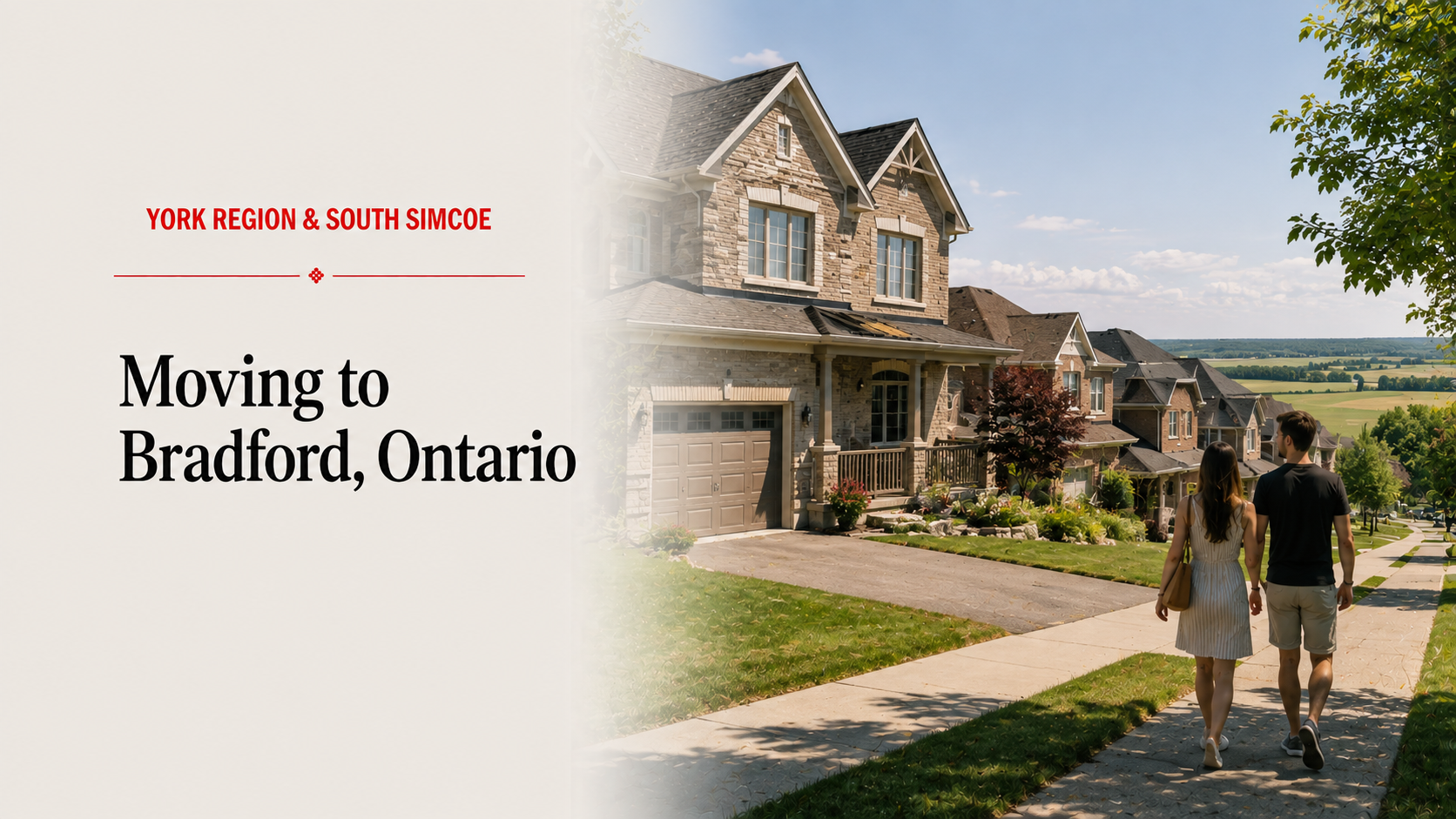
Moving to Bradford, Ontario — Pros, Cons, and What to Know (2026)
If you are considering moving to Bradford, Ontario, the most important thing to know is this: Bradford offers one of the best combinations of housing affordability, commuter access, and family-friendly amenities in South Simcoe — and it consistently outperforms higher-priced York Region towns on value per square foot. It is ideal for families and first-time buyers looking for more space without sacrificing a reasonable commute to Toronto.
Here is a complete, data-driven look at what it is actually like to live in Bradford in 2026.
What Is Bradford Like?
Bradford (officially Bradford West Gwillimbury) has transitioned from a quiet farming town into a rapidly growing suburban hub. It sits just north of the York Region border, making it the first stop in South Simcoe for buyers moving up the Highway 400 corridor. The town balances established, mature neighbourhoods near the downtown core with large, modern subdivisions on the periphery. It retains a strong sense of community while offering the big-box retail and recreation facilities of a larger city.
Who Is Bradford Best For?
Bradford is best for move-up families and first-time buyers who feel priced out of Newmarket or Aurora but still need a straightforward commute. It is also an excellent fit for downsizers who want a quieter lifestyle while remaining close to family in the GTA. If you prioritize square footage, modern community centres, and highway access over downtown walkability, Bradford is a strong match.
Who Bradford Is Not For
Bradford is not the right fit for everyone. If you want a fully walkable, urban lifestyle where you can run daily errands on foot, Bradford will feel car-dependent — particularly in the newer subdivisions on the north and east edges of town. It is also not ideal for buyers who want immediate access to downtown Toronto without a meaningful commute, or for those who prioritize a dense, culturally diverse restaurant and nightlife scene. If you are comparing Bradford to Aurora or Newmarket for walkability and urban feel, those towns will score higher. Bradford wins on value, space, and community — not on urban density.
How Is the Commute from Bradford?
The commute from Bradford is highly efficient compared to other towns at this price point.
- By Car: Bradford has direct, immediate access to Highway 400. Driving to Highway 407 takes about 20 minutes, and downtown Toronto is roughly a 50-minute drive outside of rush hour (though rush hour can push this to 75+ minutes).
- By Transit: The Bradford GO Station is located right in town on the Barrie line. The train ride to Union Station takes approximately 70 minutes, making it a viable option for hybrid or daily commuters who want to avoid the 400.
Bradford vs. Nearby Communities — How Does It Compare?
One of the most common questions buyers ask is how Bradford stacks up against the alternatives. Here is a straightforward comparison:
| Community | Typical Price Range | Commute to Toronto | Walkability | Best For |
|---|---|---|---|---|
| Bradford | Lower — best value in the corridor | 50 min drive / 70 min GO | Car-dependent | Families, first-time buyers, value seekers |
| East Gwillimbury | Similar to Bradford | 55 min drive / 65 min GO (Mount Albert area longer) | Car-dependent | Families wanting newer builds, nature access |
| Holland Landing | Slightly lower | 45 min drive / no direct GO | Car-dependent | Buyers wanting rural feel, lower density |
| Newmarket | Higher | 45 min drive / 65 min GO | Moderate — best in the corridor | Buyers wanting more urban amenities and walkability |
The bottom line: Bradford gives you the most square footage for your dollar in this corridor. Newmarket gives you more walkability and amenities at a higher price — typically $150,000–$250,000 more for a comparable detached home, with a GO commute that is roughly 10–15 minutes shorter each way. East Gwillimbury gives you newer builds and nature access at a similar price to Bradford. Holland Landing gives you a quieter, lower-density feel at a slightly lower price but with no direct GO access.
The commuter trade-off in plain language: If you commute downtown by GO train, Bradford adds about 10–15 minutes each way compared to Newmarket, but typically saves $150,000–$250,000 on the purchase price of a detached home. For hybrid workers (2–3 days per week), Bradford is often the stronger value. For daily commuters who prioritize minimizing travel time, Newmarket’s shorter GO ride and local amenity base may justify the premium.
Which Bradford Neighbourhoods Are Best?
Bradford’s neighbourhoods vary significantly depending on what you are looking for:
- Downtown Bradford / Holland Street area: Older, more established homes with mature trees and a walkable core. Best for buyers who want character and proximity to the original town centre.
- Summerlyn Village and Bond Head Road corridor: Newer subdivisions with larger lots and modern builds. Best for families wanting newer construction and community parks.
- Bradford Industrial area (east side): Less desirable for residential buyers due to proximity to commercial and industrial uses. Worth checking the surrounding land use before purchasing.
- Rural Bradford West Gwillimbury: Larger properties and acreage lots for buyers wanting space and privacy, though these require a car for everything.
Is Bradford Walkable?
Bradford is largely car-dependent. The downtown Holland Street area has the highest walkability — you can walk to groceries, a pharmacy, coffee shops, and a few restaurants. However, most of the newer subdivisions require a car for daily errands. If walkability is a priority, focus your search on properties within 10 minutes of Holland Street.
What Are the Schools Like in Bradford?
Bradford offers a mix of established and newer schools across both the public (Simcoe County District School Board) and Catholic boards.
School Zone Checklist for Bradford:
* Verify the exact zoned school for your address using the Simcoe County District School Board or Catholic board locator — do not rely on neighbourhood assumptions.
* Boundary caution: Boundaries can shift rapidly in Bradford due to new subdivision growth. Always confirm with the board directly before finalizing a purchase.
* French Immersion: Confirm whether it is offered at the elementary, middle, and high school levels in your specific zone, and whether entry requires an application or lottery. Availability varies by area.
* Feeder school path: Understand where your child will go for high school based on their elementary school assignment.
* New school construction: Several new schools have opened or are planned in Bradford’s growing subdivisions — check with the board for the most current boundary maps.
What Amenities Are Available in Bradford?
Bradford has layered its amenities well to support its growing population. Here is what you will actually find:
Grocery and Daily Essentials:
Bradford has a strong grocery lineup along Holland Street and Langford Boulevard. Major options include Zehrs (Holland Street West), Food Basics (Langford Boulevard), Reali’s No Frills (Barrie Street), and Sobeys. For specialty and cultural groceries, O Beirao (Portuguese) and Producto Mexicanos are both available locally — a sign of Bradford’s growing cultural diversity.
Healthcare and Medical Services:
Bradford has meaningful in-town medical access — you do not need to drive to Newmarket for routine care. Key options include Bradford Healthcare Centre (Holland Street East, offering family medicine, walk-in, pharmacy, and prenatal care), Holland Street Medical (full-service family practice with walk-in and on-site pharmacy), Bradford Medical Centre (family and addiction medicine, walk-in services), and Central X-Ray and Ultrasound at Shoppes at Summerlyn (diagnostics including ultrasound, x-ray, and mammography). For emergency and specialist care, Southlake Regional Health Centre in Newmarket is approximately 20 minutes by car.
Recreation:
The BWG Leisure Centre is the town’s main hub — fitness centre, swimming pools, gymnasium, and ice rinks. The Youth Recreation Centre on Colborne Street and the Youth Lounge at BWG Leisure Centre serve grades 7–12 with structured programming and drop-in space. The town also has extensive parks, splash pads, sports fields, and access to the Holland River for kayaking and fishing.
Shopping:
Holland Street is Bradford’s main retail corridor, with big-box stores, chain restaurants, and local businesses. Upper Canada Mall in Newmarket is a 15-minute drive for major mall shopping.
Local Employment and Economic Growth
Bradford is no longer just a commuter town. Recent industrial and logistics investments along Highway 400 and in the Artesian Industrial Park are adding thousands of new jobs in manufacturing, transportation, and construction support — making it increasingly viable as a place to both live and work.
Key developments underway or recently completed:
- Toromont Cat has built a $70-million heavy-equipment remanufacturing facility in Bradford’s Highway 400 Employment Lands, adding approximately 200 skilled jobs in production, mechanics, and technical roles.
- Highlight Motor Group is developing a 1.1-million square-foot headquarters and logistics park (Highlight Bradford Business Park) along Highway 400 and 5th Line, with an estimated 2,000 jobs tied to warehousing, transportation, and office operations.
- Tiltco Architectural Services has relocated a 70,000-square-foot custom window manufacturing facility to Industrial Road in the Artesian Industrial Park.
- MiTek Canada is expanding its structural building components operations within Bradford’s employment nodes.
Beyond these major employers, Bradford’s economy includes healthcare, education, retail along Holland Street, and the Holland Marsh agricultural sector — Ontario’s “vegetable garden” — which remains a significant local employer and economic anchor.
For commuters, Bradford’s proximity to Newmarket, Barrie, Vaughan, and the GTA means many residents work outside the town — but the local employment base is growing faster than most comparable communities in the corridor.
Bradford’s Future Infrastructure — The Bradford Bypass
Bradford and East Gwillimbury are anchored by one of the most significant infrastructure projects in the region: the Bradford Bypass (Highway 425), a new four-lane controlled-access freeway that will directly connect Highway 400 and Highway 404 through Bradford West Gwillimbury and East Gwillimbury.
Key facts buyers should know:
– 16.3 km of new freeway linking Highway 400 to Highway 404, with construction already underway
– Expected to cut regional travel times by up to 35 minutes across York Region and Simcoe County
– Includes widening and interchange upgrades at Simcoe County Road 88 and Highway 400, plus structures over the Holland River and the Metrolinx rail corridor
– Directly affects Bradford’s industrial employment lands and East Gwillimbury’s regional connectivity
– Supports approximately 2,200 jobs annually during construction
For buyers, this matters: once complete, the Bradford Bypass will change commute patterns, truck routes, and regional accessibility for both Bradford and East Gwillimbury. Properties near the Highway 400 corridor in Bradford are positioned to benefit from improved regional connectivity over the next decade.
What Is the Real Estate Market Like in Bradford?
In Summer 2026, Bradford remains a high-value alternative to York Region. Prices are generally lower than in neighbouring Newmarket or East Gwillimbury, allowing buyers to secure larger lots or newer builds for their budget. Inventory is currently healthy and the market is balanced, meaning buyers have options and negotiating room. Days on market are slightly longer than in the spring, giving buyers more time to make decisions without the pressure of multiple-offer situations.
For buyers: This is a reasonable window to negotiate on price and conditions. Overpriced listings are sitting longer, which creates leverage.
For sellers: Accurate pricing matters more than ever. Homes that are priced correctly for the current market are still selling — homes that are not are accumulating days on market and requiring reductions.
Pros and Cons of Living in Bradford
Pros:
* Excellent value and housing affordability compared to York Region.
* Direct Highway 400 access and a dedicated GO Station.
* Strong family amenities, including the BWG Leisure Centre.
* A mix of modern subdivisions and mature, tree-lined streets.
* Significant infrastructure investment and planned growth.
Cons:
* Holland Street (the main artery) can experience heavy traffic congestion during peak hours.
* Limited nightlife and high-end dining options within the town itself.
* Property taxes can be relatively high compared to some surrounding rural townships.
* Car-dependent outside of the downtown core.
* Rapid growth means some areas feel unfinished, with ongoing construction nearby.
Frequently Asked Questions About Bradford
Is Bradford a good place to live?
Yes. Bradford is highly rated for its safety, community facilities, and affordability, making it a popular choice for families relocating from the GTA. It consistently ranks as one of the better-value communities in the Highway 400 corridor.
Is Bradford good for families?
Yes. With numerous parks, newer schools, a major leisure centre, and a high concentration of other families, Bradford is well-suited for family living. The newer subdivisions in particular are designed around family amenities.
Is Bradford better than East Gwillimbury?
It depends on your priorities. Bradford has better GO access and slightly more established amenities. East Gwillimbury has more nature access and newer builds in some areas. Both are similarly priced. The right choice depends on your commute pattern, lifestyle preferences, and the specific neighbourhoods you are comparing.
How far is Bradford from Toronto?
Bradford is approximately 60 kilometres north of downtown Toronto. The drive takes about 50 minutes without traffic, or 70 minutes via the GO Train to Union Station.
Is Bradford walkable?
Partially. The downtown Holland Street area has reasonable walkability for daily errands. The newer subdivisions on the outskirts are car-dependent. If walkability matters to you, focus your search near the town centre.
Is Bradford a buyer’s or seller’s market?
In Summer 2026, Bradford is in a balanced market leaning slightly toward buyers, offering good inventory choices and negotiating leverage for well-prepared buyers.
What are the downsides of living in Bradford?
The main downsides are traffic congestion on Holland Street during peak hours, limited urban amenities compared to Newmarket or Aurora, car dependency outside the core, and property taxes that are higher than some rural alternatives. Rapid growth also means ongoing construction in newer areas.
Not sure if Bradford is the right fit for your move? Book a no-obligation strategy session to discuss your specific priorities and compare local communities — pambechardrealtor.ca