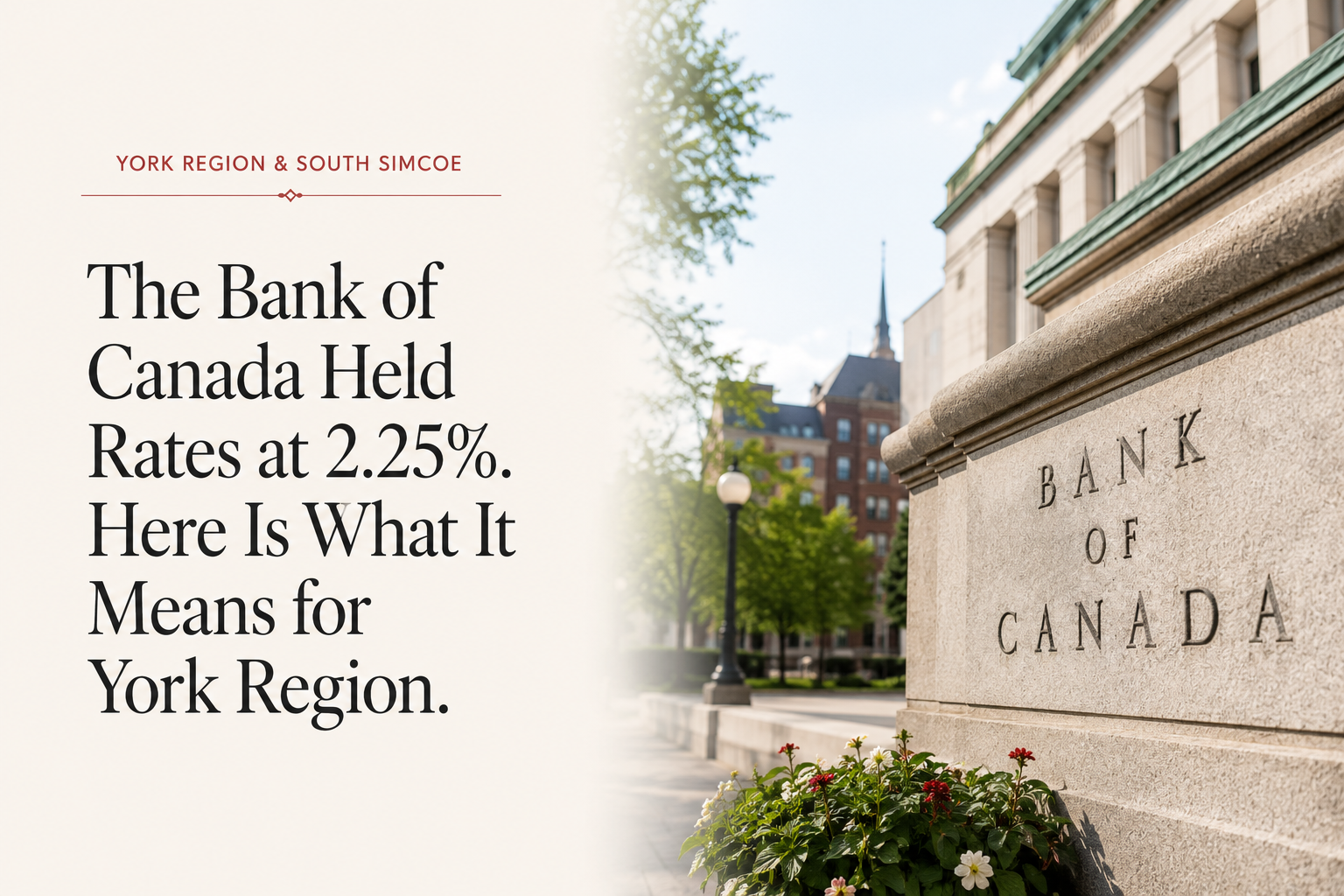
The Bank of Canada Held Rates at 2.25%. Here Is What It Means for York Region.
On July 15, 2026, the Bank of Canada announced its decision to hold the overnight lending rate steady at 2.25%. This is the sixth consecutive time the central bank has chosen to leave rates unchanged. Governor Tiff Macklem noted that economic growth has resumed after stalling earlier in the year, but uncertainty remains elevated — particularly around oil prices, the war in the Middle East, and ongoing trade negotiations with the United States.
If you are a buyer, seller, or downsizer in York Region and South Simcoe, you are likely asking one of four questions right now. This post answers all of them — with local context, not national noise.
1. Why Is My Mortgage Renewal So Much Higher If the Bank Held Rates?
This is the most common question right now, and the frustration behind it is completely understandable. If the Bank of Canada held at 2.25%, why does your renewal offer look so much worse than your original mortgage?
The answer is that the rate you are renewing into reflects where rates are today — not where they were in 2021 or 2022 when you first signed. Many homeowners in York Region locked in at historically low rates of 1.5% to 2.5% during the pandemic. Renewing those mortgages in 2026 at current rates of 4% to 5% means a significant jump in monthly payments. On a $500,000 mortgage, that can translate to roughly $700 to $900 more per month depending on your amortization.
A rate hold does not reverse that gap — it simply means the gap is not getting any wider right now. If you are approaching renewal in 2026, the most important step is to start the conversation with your mortgage broker or lender at least four months before your renewal date. Rate holds from lenders can lock in today’s rates for up to 120 days, which gives you protection if rates move before your renewal date arrives.
2. Fixed vs. Variable: Why Did My Fixed Rate Go Up If the Bank Held?
This one surprises a lot of people. The Bank of Canada’s overnight rate directly controls variable mortgage rates and home equity lines of credit (HELOCs). When the Bank holds, those rates stay flat.
Fixed mortgage rates, however, are driven by something different — the five-year Government of Canada bond yield. Bond yields move based on investor expectations about inflation, economic growth, and global risk. With geopolitical uncertainty elevated right now, bond yields have been rising even while the Bank of Canada holds steady. That is why you may have seen fixed mortgage rates tick upward in recent weeks despite no change from the Bank.
For buyers in York Region deciding between fixed and variable right now, there is no universal right answer. A fixed rate gives you certainty and protection against future hikes. A variable rate gives you the benefit of any future cuts the Bank may make — and most economists expect the Bank will eventually cut, though the timing remains unclear. The right choice depends on your risk tolerance, your financial cushion, and how long you plan to hold the property. This is a conversation worth having with a qualified mortgage professional before you commit.
3. How Long Will the Bank of Canada Hold Rates?
The honest answer is: no one knows for certain. What we do know is that the Bank has now held six times in a row, and most economists surveyed ahead of this decision expected no change until at least July 2027. The Bank’s own forecast projects inflation easing to 2.5% in the second half of 2026 and reaching the 2% target in early 2027 — which would create conditions for potential cuts.
However, the Bank was clear that risks remain. If oil prices rise again due to Middle East conflict, or if inflation proves stickier than expected, rate hikes are still on the table. The next announcement is scheduled for September 2, 2026.
For buyers in York Region who are waiting for rates to drop before making a move: waiting is a strategy, but it carries its own risks. If rates do begin to fall in 2027, buyer demand in communities like Bradford, Newmarket, and Aurora could increase quickly — which tends to push prices upward. The question is not just “when will rates drop?” but “what will the market look like when they do?”
4. Is Now a Safe Time to Buy in York Region?
A stable rate environment is genuinely good news for buyers who are ready to move. You can budget with confidence. Pre-approval rates are predictable. And the market in York Region and South Simcoe is currently balanced — meaning neither buyers nor sellers have a significant advantage, and there is room to negotiate.
That said, “safe” depends entirely on your personal situation. The stress test in Canada requires you to qualify at a rate 2% above your contract rate, which means your purchasing power is already calculated with a buffer. If you have been pre-approved and you have found a property that fits your budget and your life, the rate hold removes one layer of uncertainty from the equation.
What I tell buyers in York Region right now is this: do not let the macro headlines make the decision for you. The right time to buy is when the numbers work for your household, the property is right, and you have done your due diligence on the local market. A rate hold does not change that framework — it just confirms that the ground is not shifting beneath you today.
What This Means for Sellers and Downsizers
For sellers preparing to list in East Gwillimbury, Innisfil, or New Tecumseth, the rate hold reinforces what we have been seeing on the ground: buyers are active, but they are price-sensitive. Because borrowing costs remain where they are, buyers are calculating their monthly carrying costs carefully. Homes priced accurately based on recent, local comparable sales are moving. Homes priced based on what a neighbour received two years ago are sitting.
For downsizers, the stability of a rate hold removes the urgency that often leads to rushed decisions. You do not need to race to sell before a hike, nor wait for a cut that may be a year away. This is a good environment to plan a thoughtful transition — whether that means moving to a smaller detached home in Barrie or a condominium closer to family in Aurora.
The Bottom Line
The Bank of Canada held at 2.25% for the sixth consecutive time. The rate environment is stable, but not simple. Renewal shock is real for 2021–2023 borrowers. Fixed rates are moving independently of the overnight rate. Future cuts are possible but not imminent. And the York Region market remains balanced — which means decisions should be driven by your situation, not by headlines.
If you have questions about what this means for your specific plans — whether you are buying, selling, renewing, or just starting to think about a move — I am happy to talk through the local data with you.
Book a 20-minute call — no obligation, no sales pitch. Just a straight conversation about your situation and what the numbers look like right now in York Region and South Simcoe.