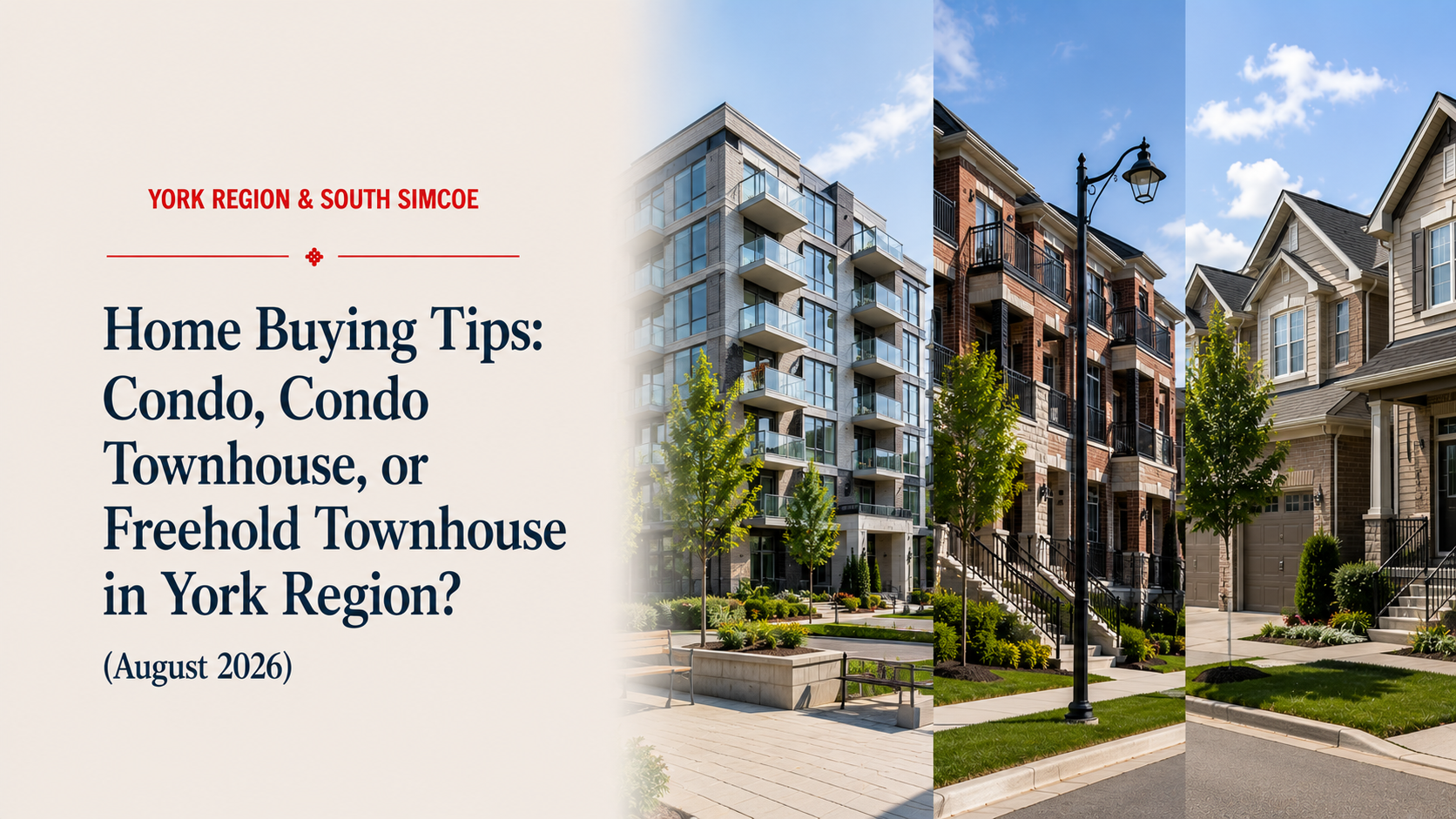
Home Buying Tips: Condo, Condo Townhouse, or Freehold Townhouse in York Region? (August 2026)
The Short Answer
For most buyers in York Region and South Simcoe, a condo apartment, condo townhouse, and freehold townhouse solve different problems. A condo apartment can suit a lower-maintenance lifestyle and a smaller footprint; a condo townhouse can add more room while keeping shared responsibilities; and a freehold townhouse can offer greater control over the home but usually places more maintenance directly on the owner. The better choice is the one that fits your full monthly carrying costs, preferred location, daily routine, and willingness to manage repairs and outdoor space.
How Do the Three Home Types Compare?
| Home type | May suit buyers who value | Questions to ask before deciding |
|---|---|---|
| Condo apartment | A lower-maintenance lifestyle, access to a specific location, and less interior or exterior space to manage. | What do the common expenses include? What rules affect pets, parking, rentals, or renovations? How will the space work if your household changes? |
| Condo townhouse | More living space or a multi-level layout, while some exterior responsibilities remain shared. | Which items are maintained by the corporation? Is there a reserve fund? Are there limits on parking, outdoor changes, or visitor access? |
| Freehold townhouse | More direct control over the home, private outdoor space, and the ability to make many changes without condo-corporation approval. | What repairs, roof, landscaping, utilities, and seasonal maintenance will become your responsibility? Is there a common-elements fee despite the freehold title? |
Why Should You Compare the Full Monthly Cost, Not Only the Purchase Price?
The purchase price is only one part of the decision. Compare property taxes, common expenses where applicable, utilities, insurance, expected maintenance, parking, and the practical cost of the commute. A condo with monthly common expenses is not automatically a poorer choice, and a freehold townhouse without those expenses is not automatically less expensive to own. The question is what you receive, what you remain responsible for, and whether the total fits your household comfortably.
Before committing to a price range, discuss the overall monthly picture with a trusted mortgage broker and review legal and condominium documents with the appropriate professional. That gives you a clearer comparison than a list price alone.
Are Condo Fees a Reason Not to Buy a Condo or Condo Townhouse?
No. Condo fees are a cost to understand, not a reason by themselves to reject a property. They can pay for shared building or site maintenance, insurance for common elements, amenities, and contributions to the reserve fund. The important question is whether the fee, the included services, and the condominium corporation’s financial condition make sense together.
For a resale condominium, a status certificate contains key information about the corporation, including common expenses, the reserve fund, governing documents, special assessments, and litigation disclosures. The Condominium Authority of Ontario recommends that buyers review it with legal counsel. This is one of the most important due-diligence steps in a resale condo purchase.
What Does the Current Local Market Mean for Buyers Choosing a Home Type?
Buyers still need to be prepared, but they have time to compare alternatives carefully in many segments. In York Region’s July 2026 TRREB report, all home types combined showed 5.0 months of inventory and an average sale-to-list ratio of 98 per cent. That is consistent with a balanced, price-sensitive market rather than a market where every property has the same level of competition.
In the broader Simcoe County July 2026 report, the all-home-type average was 6.3 months of inventory and a 96 per cent sale-to-list ratio. Simcoe County is broader than South Simcoe, so it is only regional context, not a value estimate for an individual town or property. In both areas, the practical takeaway is to compare active alternatives and recent comparable sales before deciding whether a condo, condo townhouse, or freehold townhouse represents the better value for your needs.
Should You Prioritize More Space or a Better Location?
Prioritize the factor that affects your household most often. A larger townhouse can make daily life easier for a growing family or someone who works from home. A smaller condo closer to a GO station, work, services, or family may reduce commuting and simplify the week. There is no universal right answer, which is why it helps to test the actual route, neighbourhood, and property type before committing.
For buyers comparing commute-friendly communities, begin with the Bradford GO commuting guide and check individual trips through the GO Transit trip planner. For a broader local comparison, explore the Moving to York Region and South Simcoe hub.
What Should You Review Before Offering on a Condo or Townhouse?
- Compare the total monthly carrying costs, including applicable common expenses and property taxes.
- For a resale condominium, arrange for a condition on review of the status certificate where appropriate and obtain legal advice on the documents.
- Confirm what the corporation maintains, what you maintain, and what is included in the fee.
- Check rules that could affect your routine, including pets, parking, visitors, rentals, renovations, storage, and use of outdoor space.
- For a freehold townhouse, budget realistically for roof, exterior, landscaping, snow removal, utilities, and other direct owner responsibilities.
- Compare current active listings and relevant recent sales in the same home type and neighbourhood before deciding on an offer strategy.
Frequently Asked Questions
Is a condo apartment or townhouse better for a first-time buyer?
Neither is automatically better. A condo apartment can suit buyers who value lower-maintenance living and a particular location. A townhouse can suit buyers who need more space or a multi-level layout. Compare the full monthly cost, the building or complex condition, the commute, and how long the home is likely to work for your household.
Are condo fees a reason not to buy?
No. Condo fees should be examined alongside the services they fund, the reserve fund, the corporation’s financial position, and the responsibilities they remove from the owner. Review the status certificate and obtain appropriate legal advice before deciding whether the fee is reasonable for that property.
What is a condo status certificate?
A status certificate is a document for a resale condominium that provides important information about the unit and the condominium corporation. It can include common expenses, reserve-fund information, governing documents, special assessments, insurance, and litigation disclosures. The Condominium Authority of Ontario recommends buyers review it with legal counsel.
Is a freehold townhouse always better than a condo townhouse?
No. A freehold townhouse can provide more direct control and fewer condominium rules, but it also places more maintenance and repair responsibility on the owner. A condo townhouse can be a practical choice when shared maintenance and a predictable common-expense structure fit your needs. The right choice depends on the individual property, the complex, and your lifestyle.
Can buyers negotiate in York Region and South Simcoe right now?
Negotiation depends on the property, price, condition, location, and competing interest. July 2026 regional data suggests buyers may have room to compare options in some segments, but desirable properties can still attract competition. Review current active listings and relevant recent sales before deciding on an offer strategy.
What should I compare before making an offer?
Compare the property against active alternatives and recent comparable sales, then confirm the full monthly cost, commute, maintenance responsibilities, rules, parking, storage, and future household fit. For a resale condo, make sure the status-certificate review and legal advice are handled appropriately.
Sources and Next Steps
Last updated: August 2026. Local market figures are drawn from TRREB’s July 2026 York Region report and the July 2026 Simcoe County report. Condominium document guidance is from the Condominium Authority of Ontario.
If you are deciding between a condo, condo townhouse, and freehold townhouse, I can help you compare a short list using the same budget, home type, commute day, and priorities. Download the First-Time Buyer Playbook or book a 15-minute conversation to begin.
FIRST-TIME BUYER SUPPORT
Need a calmer way to compare your options?
Get the free First-Time Buyer Decision Kit, including Pam’s local Playbook and printable Home Comparison Sheet. When you are comparing real homes or communities, you can also bring two or three options to a no-pressure Buyer Shortlist Conversation.