Home Buying Tips: How Do I Know Which York Region Home Is Better Value? (August 2026)
The better value is not automatically the home with the lower asking price. In York Region and South Simcoe, the better-value home is the one whose price, condition, location, commute, layout, and likely next steps fit your real life and compare well with the alternatives buyers can choose today.
That matters in a market where buyers have time to compare. A home that looks less expensive at first can become the weaker choice if its layout does not work, its condition needs more attention than expected, or its location adds a daily compromise you will feel for years.
What Should I Compare When Deciding Which Home Is Better Value?
Start by separating asking price from overall value. Asking price is an invitation to consider a home. Value is the evidence that supports what you are paying for the location, condition, layout, buyer appeal, and lifestyle fit.
According to July 2026 TRREB data, published in August 2026, York Region had about 5.0 months of inventory and an average sale-to-list ratio of 98%, while the broader Simcoe County reporting area had 6.3 months of inventory and a 96% sale-to-list ratio. York Region and Simcoe County are reporting geographies, not one uniform market. Simcoe County data provide broader context and may not represent Bradford West Gwillimbury, Innisfil, or New Tecumseth specifically.
These figures are aggregate completed-sale benchmarks, not offer percentages, expected discounts, negotiation targets, or a valuation formula for an individual home. A buyer’s useful comparison set is much narrower: the same community, property type, price band, recent local sales, and the active alternatives available that week. TRREB Market Watch remains the primary source for the current regional context.
What Should I Compare Besides the Asking Price?
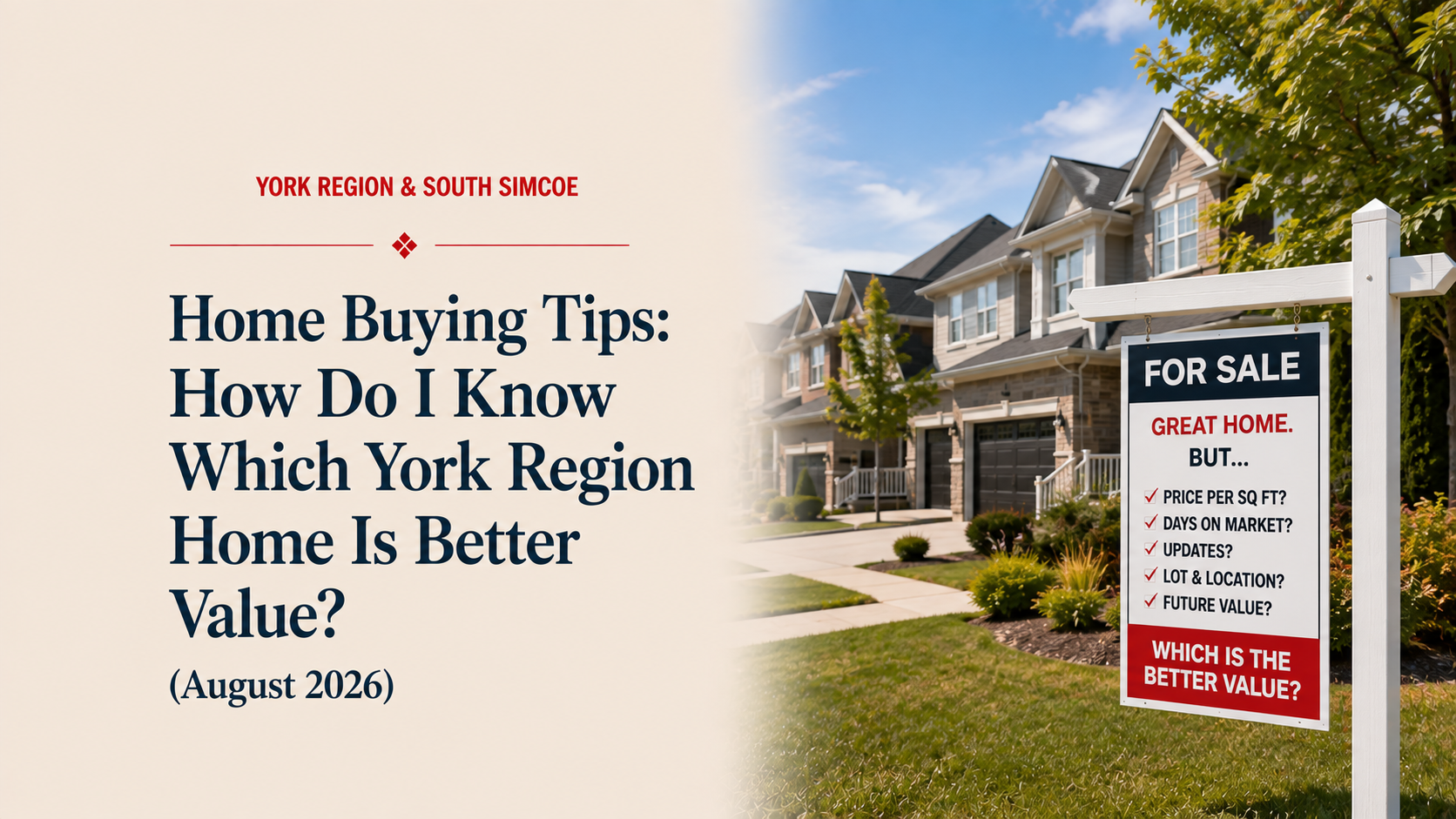
A useful comparison looks at the complete decision. The table below is not a replacement for professional due diligence. It is a way to stop one visible feature, such as a renovated kitchen or a lower asking price, from deciding the entire purchase for you.
| Compare this | Questions to ask |
|---|---|
| Direct local alternatives | What similar homes have sold recently in the same area, and what active listings will buyers compare against this one? |
| Condition and maintenance | What has been updated, what should be investigated further, and which parts of the home may need attention after closing? |
| Layout and daily fit | Will the bedrooms, storage, stairs, work space, parking, and outdoor space work for the next stage of your life? |
| Location and commute | How does the actual morning and evening route work, including the first and last kilometre to GO or the highway? |
| Future buyer pool | When you eventually sell, which buyers are likely to appreciate this home’s location, layout, and practical strengths? |
Is the Lower-Priced Home Always the Better Deal?
No. A lower price may reflect a genuine opportunity, but it may also reflect location, condition, layout, needed maintenance, difficult access, or a smaller future buyer pool. The right question is: what am I receiving and what am I giving up for this price difference?
For example, a home closer to a GO station may have a higher asking price than a similar home farther away. The better value depends on whether that access changes your household’s daily routine enough to matter. The same is true of a main-floor layout for a downsizer, a usable work-from-home space, or a finished lower level for a growing family.
How Should I Compare Two Homes at a Similar Price?
When two homes are priced similarly, compare the reasons behind the price rather than choosing the one with the most attractive photos. Visit at a time that reflects your real routine, note what feels difficult as well as what looks appealing, and compare the current alternatives available in the same price range.
A simple one-page comparison can help: list the buyer priorities that cannot be compromised, the items that can be improved later, and the trade-offs each home requires. This is especially helpful when one home is newer but farther from work, or one is closer to transit but needs more preparation.
Should I Choose the Better Location or the Better House?
It depends on which compromise affects your household most often. Cosmetic features and some interior finishes can be changed over time, while location, commute, lot position, street environment, and access to daily services usually cannot. For York Region and South Simcoe buyers, test how each home works on an ordinary weekday, not only how it looks during a showing.
Use the Best Commuter Towns Near Toronto comparison when commute is a major factor. If you are deciding between towns, the How to Choose the Right York Region Community guide can help you turn lifestyle preferences into a practical shortlist.
What If a Home Needs Work?
A home that needs work can still be the better value if the location, layout, and price position are right for you. The key is to distinguish a cosmetic preference from a functional, safety, or major-system concern that needs proper investigation. Your offer strategy and due-diligence choices should reflect the home, the market conditions, and your own comfort with the work involved.
This is not a reason to automatically reject a resale home. It is a reason to compare the whole decision. When comparing a renovated home with a cheaper home that needs work, compare the known up-front price with the uncertain scope, disruption, timing, and contingency involved in the work. Do not assume either choice is automatically better. For a broader property-type comparison, read New Build vs. Resale in York Region and South Simcoe.
A Practical Home Comparison Plan
Before making an offer, choose the two or three homes you are seriously considering and compare them against the same criteria: local evidence, condition, layout, commute, lifestyle fit, and the buyer pool that may care about those same strengths later. If you are buying with a sale in the background, also consider how the timing of both moves affects your options.
Send me the two or three homes you are comparing. I can help you review the local evidence, active competition, commute and lifestyle trade-offs, and practical next steps before you decide. Book a 15-minute conversation to start with the homes you are actually considering.
Frequently Asked Questions About Comparing Home Value
Is the lower-priced home always the better value?
No. A lower price may reflect an opportunity, but it may also reflect location, condition, layout, maintenance needs, access, or a smaller future buyer pool. Compare what you receive and what you give up at each price point.
How do I know if a home is priced fairly in York Region?
Compare recent local sales, active alternatives, the home’s condition, layout, and location. A fair price is supported by evidence from similar homes, not by an asking price alone.
How should I compare two homes at the same price?
Compare the current alternatives, condition, layout, location, commute, practical daily fit, and likely future buyer appeal. Use the same priorities for both homes rather than letting one attractive feature decide the purchase.
Does a shorter commute make a home better value?
It can, if the saved time and transit or highway access materially improve your daily routine. Test the actual route at the times you would use it and weigh that benefit against the home’s price, condition, and layout.
Should I choose the better location or the better house?
It depends on which compromise affects your household most often. Cosmetic features and some interior finishes can change over time, while location, commute, lot position, street environment, and access to daily services usually cannot. Compare how each home works on an ordinary weekday, not only how it looks during a showing.
Can a home that needs work still be good value?
Yes. It may be good value when the location, layout, and price position suit you, but the condition should be assessed carefully as part of your overall due diligence and offer strategy.
How do I compare a renovated home with a cheaper home that needs work?
Compare the known up-front price with the uncertain scope, disruption, timing, and contingency involved in the work. A renovated home may reduce immediate projects, while a cheaper home may still be the better fit if its location, layout, condition findings, and overall price position work for you.
How does the current market affect what I should offer?
Current market conditions help frame the conversation, but an offer should be based on the individual home, recent comparable sales, active competition, property condition, and your own priorities. Regional averages are context, not a formula.
Sources
Last reviewed: August 2026. Market context uses July 2026 TRREB reporting, published in August 2026. Regional market context is drawn from the official Toronto Regional Real Estate Board Market Watch reports. Market conditions vary by neighbourhood, property type, price range, active competition, and timing.
FIRST-TIME BUYER SUPPORT
Need a calmer way to compare your options?
Get the free First-Time Buyer Decision Kit, including Pam’s local Playbook and printable Home Comparison Sheet. When you are comparing real homes or communities, you can also bring two or three options to a no-pressure Buyer Shortlist Conversation.