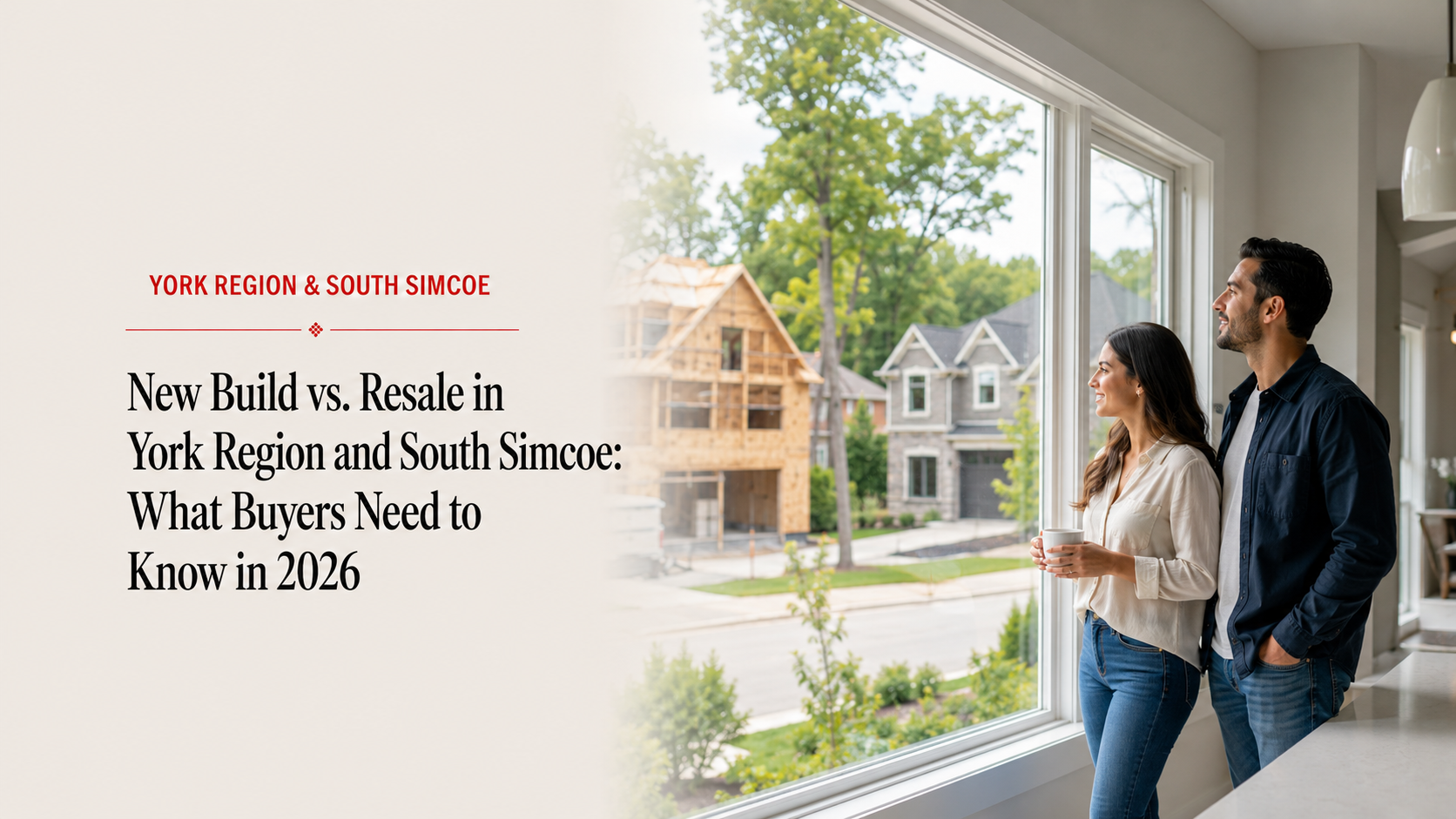
New Build vs. Resale in York Region and South Simcoe: What Buyers Need to Know in 2026
Should I buy pre-construction or completed inventory in 2026?
In the current market, completed inventory is the lower-risk option for most buyers. With pre-construction, you are locking in a price today for a home that will not be ready for 12 to 24 months — during which time market conditions, your personal finances, and interest rates can all change. Completed inventory gives you a fixed price, a known closing date, and the ability to inspect the finished product before committing.
Pre-construction can make sense if you have a very long timeline, want a specific floor plan that is not available in completed inventory, or are buying in a community where long-term infrastructure investment (GO expansion, Bradford Bypass) is expected to drive future value. But the uncertainty is real, and buyers who purchased pre-construction at 2022 prices are now closing on homes worth less than they paid.
Can a builder delay my closing date in Ontario?
Yes — and this is one of the most important things to understand before signing a pre-construction agreement. Ontario’s new home purchase agreements allow builders to extend the closing date under specific circumstances, and the Tarion warranty program sets out the rules for permissible delays.
Builders can delay closing for reasons including municipal delays, labour disruptions, and weather. The agreement will specify how much notice they must give and how many times they can extend. In practice, delays of six months to a year beyond the original closing date are not uncommon in the current environment. If you are buying pre-construction, have a lawyer review the agreement before signing — specifically the closing date provisions and the delay notification requirements.
Do I need a real estate agent when buying new construction?
Yes — and the builder pays the buyer’s agent commission, so there is no cost to you for having representation. The builder’s sales representative works for the builder, not for you. Their job is to sell the builder’s product at the best possible price and terms for the builder.
A buyer’s agent who has experience with new construction purchases can review the agreement of purchase and sale before you sign, identify clauses that are unfavourable to you, negotiate on upgrades and incentives, and help you understand what you are actually agreeing to. Given the complexity of new construction contracts — which are significantly longer and more detailed than a standard resale agreement — having independent representation is strongly advisable.
Can I negotiate incentives with builders right now?
Yes — more so than at any point since 2020. With new-home sales still below historical norms and completed inventory sitting on the market longer, builders are offering incentives that were not available during the 2021 to 2023 period. Common incentives in the current market include free upgrade packages, reduced development charge caps, extended deposit structures, and in some cases, price reductions on completed inventory.
The key is knowing what to ask for and understanding which incentives have real value versus which are marketing framing. A free upgrade package that replaces standard finishes with slightly better standard finishes is not the same as a genuine price reduction. An experienced buyer’s agent can help you evaluate what is actually being offered.
Which is better for long-term resale value: a new build or an established neighbourhood?
This depends heavily on location and the specific community. As a general principle, established neighbourhoods with mature trees, walkable amenities, good schools, and strong community identity tend to hold value well over time because the things that make them desirable cannot be replicated by new development.
New builds in communities with strong infrastructure investment — GO expansion, highway access, employment growth — can also appreciate well over time, particularly if you are buying early in the development cycle. The risk is that you are buying based on a future state that has not yet materialized.
In the York Region and South Simcoe context, communities like Holland Landing, Aurora, and established Bradford neighbourhoods have a track record of stable demand. East Gwillimbury and the Bradford Bypass corridor have strong long-term infrastructure tailwinds but are earlier in their development cycle. Neither is universally better — the right answer depends on your timeline and what you value in a neighbourhood.
What is the safest way to compare the total cost of a new build versus resale?
The safest approach is to build a full cost comparison spreadsheet for each option before making a decision. For the new build, include: base price, HST net of rebate, upgrades, lot premium, development charge cap (if applicable), Tarion enrollment fee, legal fees, and any occupancy fee period costs. For resale, include: purchase price, Ontario Land Transfer Tax, legal fees, title insurance, home inspection, and any immediate repairs identified in the inspection.
Once you have the all-in cost for each option, compare them against the current market value of comparable properties — not the list price. A comparative market analysis based on verified TRREB sales data will tell you whether the resale home is priced fairly and give you a benchmark for evaluating the new build’s pricing relative to the market.