What Is the Most Important Thing a Seller Can Do Right Now? (York Region Summer 2026)
Direct Answer: The single most important thing a seller can do in York Region right now is price accurately from day one — based on what buyers are actually paying in the last 60 to 90 days, not what a neighbour achieved in 2024 or what the assessed value suggests. In a market where 75% of homes are selling below asking price, where listing terminations are elevated, and where discounted new builds are now competing for the same buyers, the sellers who get this right do not just sell faster. They sell for more.
That answer is simple. The reasoning behind it is worth understanding in full, because the current market conditions in York Region are more nuanced than most sellers realize when they start thinking about listing.
Why Pricing Accuracy Is the Single Most Leveraged Decision
In a strong seller’s market, pricing strategy has some margin for error. Buyers are competing, inventory is low, and a home priced 5% above market might still attract an offer within the first two weeks. York Region in Summer 2026 is not that market.
With 4.8 months of supply, 75% of homes selling below asking, and an average list-to-sale ratio of 97%, the market is telling sellers something clear: buyers are present and transacting, but they are not overpaying. A well-priced home will find a buyer. An overpriced home will find silence.
The cost of overpricing is not just a slower sale. It is a cascade of consequences that compounds over time. The first two weeks on market are when a listing attracts the most attention from active buyers and their agents. Buyers who have been watching the market for months see every new listing immediately. If the price does not align with comparable sales, those buyers move on — and they rarely come back. After two to three weeks of minimal activity, the seller faces a choice: reduce the price or terminate the listing. Either path signals to the remaining buyer pool that something is wrong, which further erodes negotiating leverage.
The sellers who avoid this pattern are the ones who do the pricing work before listing, not after the market gives them feedback.
The New Competitive Reality: Discounted New Builds
There is a new variable in the York Region seller’s equation in 2026 that did not exist at the same scale two years ago: discounted new construction.
GTA new-home data for June 2026 shows benchmark single-family new-home prices down 10.7% in a single month and 15.5% lower year over year. New-home sales in June 2026 were described as one of the weakest June readings on record, even though sales volume was double the prior year’s depressed level. Builders are sitting on elevated unsold inventory and cutting prices to move it.
This matters for resale sellers because buyers in certain price ranges now have a genuine alternative. A buyer looking at a $1.4 million resale detached home in York Region is also looking at what a new build in the same corridor costs after builder incentives and price reductions. If the new build is meaningfully cheaper and offers modern finishes, the resale seller needs to account for that competition in their pricing and presentation strategy.
| Market Segment | York Region Resale | GTA New Construction |
|---|---|---|
| Sales volume trend | Up 10–21.5% YoY | Up YoY but near record lows historically |
| Price trend | Down 6.2% YoY (avg) | Down 15.5% YoY (benchmark single-family) |
| Monthly price movement | Stable to slightly soft | Down 10.7% in June alone |
| Inventory conditions | Elevated but manageable | Elevated unsold inventory, builders discounting |
| Buyer leverage | Moderate — depends on segment | High — buyers have significant negotiating power |
| Who is most affected | Higher price points, condo segment | All segments, especially entry-level new builds |
The practical implication for resale sellers is this: the new-build competition is most relevant at the higher end of the detached market and in communities where new development is active. For entry-level and mid-range detached homes in established communities like Bradford, Newmarket, and Aurora, the new-build alternative is less direct — buyers in that segment are often looking for established neighbourhoods, mature trees, and proximity to existing amenities that new developments cannot replicate. But for sellers above $1.4 million, the new-build comparison is a real factor in how buyers evaluate value.
What Preparation Actually Means in This Market
Pricing accuracy is the foundation, but preparation is what determines whether a well-priced home sells in the first three weeks or sits for six. In a market where buyers are selective and have options, presentation matters more than it did when demand was outpacing supply.
Preparation in the current market means three things:
Condition. Buyers in the $800,000 to $1.4 million range are not expecting perfection, but they are expecting a home that has been maintained and shows well. Deferred maintenance — a worn roof, dated mechanical systems, cosmetic issues that have been ignored — gives buyers a reason to negotiate down or walk away. Addressing the most visible issues before listing removes those objections before they become negotiating points.
Presentation. Professional photography, clean staging, and a well-organized showing experience are not optional in the current market. Buyers are comparing your listing against every other active listing in the price range, and the ones that photograph well attract more showings. More showings create more competition. More competition protects your price.
Timing. Summer 2026 is an active market, but it is not the spring peak. The buyer pool is smaller and more selective than it was in April and May. Listing now means competing for a buyer pool that is present but not as deep as it will be in September when fall inventory also increases. If you are not ready to list with accurate pricing and strong presentation, waiting until you are fully prepared is better than rushing to market and generating the kind of feedback that forces a price reduction.
The First 21 Days Are Everything
In the current York Region market, the first 21 days on market are the most critical period of a listing. This is when the listing is fresh, when active buyers and their agents are paying the most attention, and when the pricing signal is clearest. A home that generates showings and offers in the first three weeks is a home that sells at or near asking price. A home that sits through the first three weeks without meaningful activity has already lost its best opportunity.
The sellers who understand this go into the market prepared. They have done the pricing work based on current comparable sales. They have addressed the visible condition issues. They have invested in professional photography and staging. They have a clear strategy for the first week, including how they will handle showings, how they will communicate with their agent, and what their response will be if an offer comes in below asking.
The sellers who do not understand this go into the market with optimism and adjust their strategy after the market gives them feedback. By then, the best buyers have moved on.
The Bottom Line
The most important thing a seller can do right now is make the pricing decision based on what the current market is actually doing — not what it was doing 12 or 18 months ago, not what the assessed value says, and not what a neighbour achieved in a different market cycle. The York Region resale market is active and transacting. Sellers who enter it with accurate pricing, strong presentation, and a clear first-21-day strategy are finding buyers. The ones who do not are generating the termination and price reduction statistics that define this market.
The data is clear. The strategy is straightforward. The execution is what separates the sellers who achieve their goals from the ones who spend months wondering why their listing is not moving.
Frequently Asked Questions
What is the most important thing a seller can do right now in York Region?
Price accurately from day one, based on comparable sales from the last 60 to 90 days in your specific community and property type. In a market where 75% of homes are selling below asking price and listing terminations are elevated, pricing accuracy is the single most leveraged decision a seller makes. Overpriced listings lose their best buyers in the first two weeks and rarely recover that momentum.
How do I know if my home is priced correctly for the current York Region market?
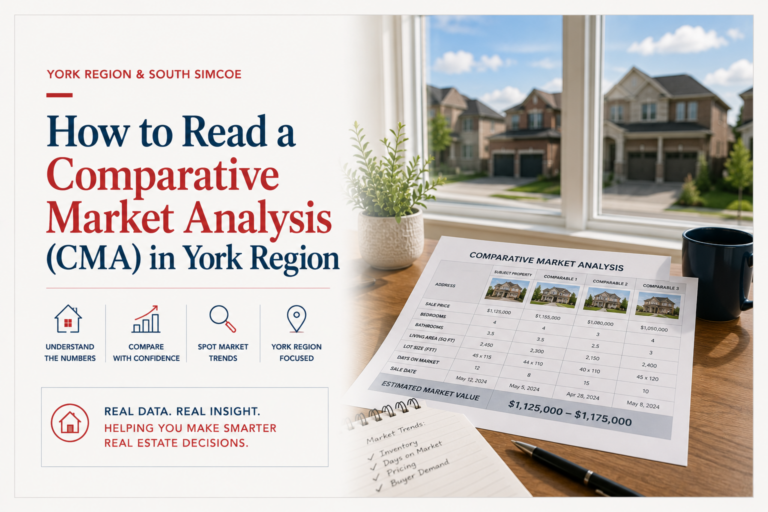
The most reliable method is a comparative market analysis (CMA) using sold data from the last 60 to 90 days for homes that are genuinely comparable — same property type, similar square footage, same community, similar condition. Comparable sales from 2024 or earlier are not reliable benchmarks in the current market. York Region average prices are down 6.2% year over year, and some communities like East Gwillimbury have seen 15% year-over-year declines. Your pricing needs to reflect where the market is now, not where it was.
Should I do renovations before listing my home in York Region?
Not necessarily — but you should address visible deferred maintenance and condition issues that give buyers a reason to negotiate down. In the current market, buyers are selective and comparing every listing against its alternatives. A home that shows well and has no obvious condition concerns removes negotiating objections before they become price reductions. Major renovations rarely return their full cost in the current market. Focus on the issues that affect first impressions: curb appeal, clean and decluttered interiors, and any visible maintenance items that a buyer will notice on a showing.
How does the new-home price drop affect resale sellers in York Region?
GTA new-home benchmark prices fell 10.7% in a single month in June 2026 and are 15.5% lower year over year. This matters for resale sellers because buyers in certain price ranges — particularly above $1.4 million — now have a discounted new-build alternative to compare against resale listings. For entry-level and mid-range detached homes in established communities, the new-build competition is less direct. But for higher-priced resale homes, the new-build comparison is a real factor in how buyers evaluate value, and resale sellers need to account for it in their pricing and presentation strategy.
Is summer a good time to sell in York Region?
Summer 2026 is an active market with real buyer demand — 1,165 homes sold in York Region in May 2026, up 10% year over year. However, the summer buyer pool is smaller and more selective than the spring peak. Sellers who are fully prepared — accurate pricing, strong presentation, no deferred maintenance — can achieve good outcomes in the current summer market. Sellers who are not fully prepared may find it more strategic to wait until September, when buyer activity typically increases again, rather than entering the market before they are ready and generating the kind of feedback that forces a price reduction.
If you are thinking about listing in York Region or South Simcoe and want to understand exactly what the current market conditions mean for your property, a 60-minute strategy session gives you the local data behind your decision. Book a no-obligation conversation at pambechard.com. Pam Bechard, Listing Strategist with Royal LePage RCR Realty, will walk you through the current conditions for your specific situation.
About Pam Bechard
Pam Bechard is a Listing Strategist with Royal LePage RCR Realty serving York Region and South Simcoe, Ontario. With nearly 15 years of experience, she works with buyers, sellers, relocators, and downsizers navigating the YRSS market. Her approach is data-first, pressure-free, and grounded in verified local market intelligence.
Get your free home value estimate → pambechard.com · 905-716-2736 · pambechard@royallepage.ca