How to Read a Comparative Market Analysis (CMA) in York Region
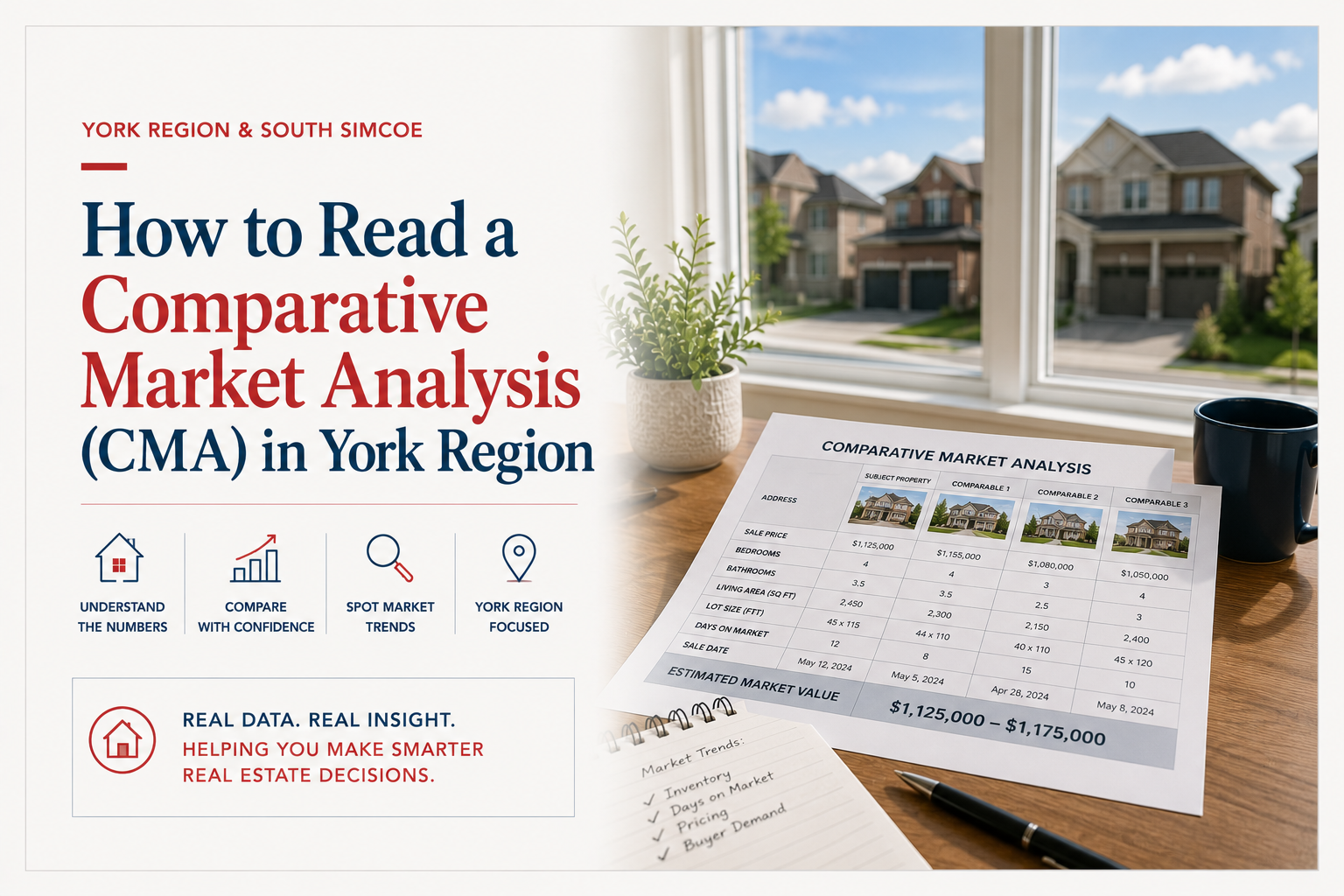
A Comparative Market Analysis, or CMA, is an estimate of a home’s market value built from recent comparable sales, current active listings, and recent expired listings, adjusted for differences between those properties and the home being evaluated. Understanding what goes into it helps a seller evaluate a price recommendation rather than simply accept or reject the number.
What Goes Into a CMA
- Comparable sales: similar homes that have actually sold recently in the same or a nearby area
- Active listings: similar homes currently for sale, which represent the competition a new listing will face
- Expired or withdrawn listings: homes that did not sell, which often signal where pricing went wrong
- Adjustments: additions or subtractions to account for differences in size, condition, lot, upgrades, and location between the comparables and the subject home
How to Evaluate a CMA, Not Just Accept It
A useful CMA explains why each comparable was chosen and how each adjustment was calculated, not just a final number. A seller reviewing a CMA can reasonably ask which comparables were closest in size, age, and location, and why any adjustments were made in a particular direction.
Why This Does Not Undermine the Realtor’s Role
Understanding a CMA does not replace the judgment involved in building one. Local knowledge, how a specific street or school catchment is performing, how a property shows in person, and how current buyer behaviour is trending all feed into a CMA in ways that are difficult to fully capture from raw data alone. Reading a CMA well makes the conversation with a listing strategist more productive, not less necessary.
Quick Answers
Is a CMA the same as an appraisal?
No. An appraisal is typically required by a lender and prepared by a licensed appraiser. A CMA is a market-based estimate prepared by a real estate professional to guide a listing price decision.
How many comparable sales should a CMA include?
Enough to show a consistent pattern, typically several recent, closely comparable sales rather than just one or two.
Why would two CMAs on the same home come up with different numbers?
Different comparables, different adjustments, or different views on current market direction can all produce different numbers. Asking how each was built is more useful than comparing the final figures alone.
Can I request to see the comparables used in my CMA?
Yes. A seller can reasonably ask to see which properties were used and why.
Does a CMA predict my final sale price?
No. It estimates a defensible starting list price based on current data. The final sale price depends on market response once the home is actually listed.
Want the numbers that apply to your specific home or move? Get a free, no-obligation home value estimate at pambechard.com. Pam Bechard, Listing Strategist with Royal LePage RCR Realty, will follow up directly with the comparable sales behind your number.
About Pam Bechard
Pam Bechard is a Listing Strategist with Royal LePage RCR Realty serving York Region and South Simcoe, Ontario. With nearly 15 years of experience, she works with buyers, sellers, and downsizers navigating the YRSS market. Her approach is data-first, pressure-free, and grounded in verified local market intelligence.
Get your free home value estimate → pambechard.com · 905-716-2736 · pambechard@royallepage.ca