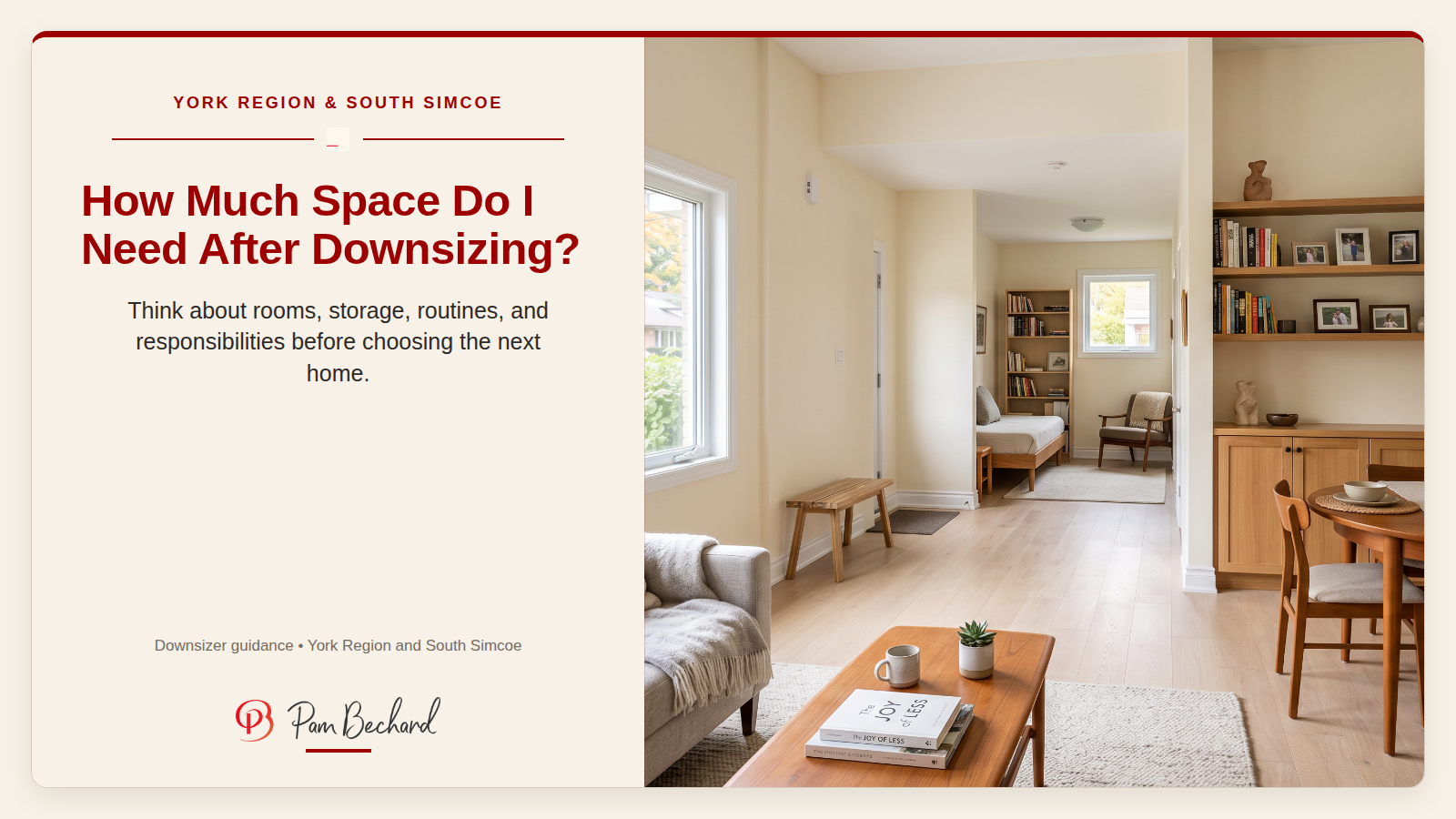
How Much Space Do I Need After Downsizing in York Region or South Simcoe?
There is no universal amount of space you need after downsizing. The better question is which rooms, storage, routines, and responsibilities your next home must support—and which space you are paying for, heating, maintaining, or managing without using it often.
Quick answer: Start with your ordinary week, not an ideal floor plan. Record what you use, what you need occasionally, what has become difficult to maintain, and what you are not ready to give up.
How Much Space Do I Really Need After Downsizing?
Two homes with similar square footage can feel completely different. The layout, stairs, storage, parking, outdoor responsibilities, room placement, and distance between everyday activities may matter more than the number on the listing sheet.
A smaller home can be a poor fit if it removes a room you use every week or creates a new responsibility that does not suit your routine. A larger home can also be a poor fit if much of the space is rarely used and the work of maintaining it is one of the reasons you are considering a move.
What Do You Actually Use in an Ordinary Week?
For seven days, notice what you do rather than what you think a future home should contain. The goal is not to justify a move. It is to make the comparison more honest.
- Where do you prepare meals, eat, work, read, and relax?
- Which rooms are used every day, every week, seasonally, or almost never?
- What needs to remain easy for visitors, family, hobbies, or overnight guests?
- Which storage is genuinely used, and which items are being stored because there is room?
- What parts of the home take the most time, energy, or coordination to maintain?
- Which spaces are important because of how they support people or routines, even if they are not used daily?
Which Spaces Should Stay, Change, or Be Released?
| Space or responsibility | Ask yourself | Possible next step |
|---|---|---|
| Daily-use space | Does the next home need to make this easier or more accessible to the ordinary routine? | Keep it as a non-negotiable requirement. |
| Occasional space | How often is it used, and what would be a realistic alternative? | Compare a dedicated room with a flexible or shared space. |
| Storage | What is used, what is sentimental, and what is being kept only because there is room? | Sort before comparing floor plans. |
| Maintenance responsibility | Is this one of the reasons the current home no longer fits? | Compare the responsibility, not only the size of the next home. |
Do not treat this table as a prescription. It is a way to identify the trade-offs that deserve attention before you compare actual homes.
How Much Space Do Guests, Family, and Hobbies Need?
Many downsizing decisions become difficult because an occasional need is treated as though it must have a permanent room. The opposite can also happen: a household gives up a space that is important to family, work, or a hobby without deciding what will replace it.
Ask how often the need occurs, whether the arrangement must be private, whether a flexible room could work, and whether the compromise would feel acceptable after the move. A smaller home should solve a problem without quietly creating another one.
What Storage Do You Need After Downsizing?
Storage is not only a closet count. It can include seasonal items, tools, mobility equipment, hobby materials, family belongings, outdoor equipment, and the items needed for ordinary maintenance.
- List what must remain accessible rather than merely what must be kept.
- Separate daily-use items from seasonal or occasional items.
- Measure larger items that may not fit a smaller room, locker, garage, or storage area.
- Ask whether the next home changes who is responsible for exterior or shared spaces.
- Do not assume a storage locker, garage, basement, or shared space is interchangeable with the current arrangement.
How Can I Compare Real Homes Instead of Abstract Floor Plans?
Once you know what the ordinary week requires, compare actual homes through the routines they support. Walk through the entry, kitchen, laundry, storage, sleeping areas, outdoor spaces, parking, and the route between the places you use most.
Compare a bungalow, smaller freehold home, condo apartment, or condo townhome through its full set of responsibilities and trade-offs. The Downsizing in York Region and South Simcoe hub provides the broader decision path, while the Downsizer Decision Kit can help organize what must stay, what can change, and what deserves more time.
How Can the Space Question Differ in York Region and South Simcoe?
In York Region and South Simcoe, the amount of space that feels right can depend on the home type and the routine you want to keep. A condo apartment in Richmond Hill, Markham, Vaughan, Newmarket, or Aurora may shift more responsibility outside the suite, but you still need to assess storage, parking, locker space, visitor arrangements, shared-space rules, and the route from parking to the unit.
A bungalow, condo townhome, or smaller freehold home in East Gwillimbury, Georgina, Bradford West Gwillimbury, Alliston, Innisfil, or another lower-density setting may offer a different balance of private storage, outdoor space, parking, driving, maintenance, and distance from regular activities. The question is not which form is best. It is whether the particular home supports your daily routine, family visits, belongings, transportation pattern, and the responsibilities you are willing to keep.
| Home type or setting | Space and responsibility questions to test |
|---|---|
| Condo apartment | Is suite storage sufficient? Is there a locker? How will parking, visitors, groceries, elevators, shared spaces, and building rules affect ordinary life? |
| Condo townhome | Does the layout require stairs? What storage, exterior, parking, fee, and shared-responsibility trade-offs apply to this specific complex? |
| Smaller freehold home | Which maintenance tasks remain? Do the garage, basement, shed, driveway, yard, and storage still align with the purpose of downsizing? |
| Bungalow | Does the one-level layout support the rooms and storage actually used? What site, basement, laundry, garage, outdoor, and maintenance responsibilities remain? |
| Lower-density or edge-of-town home | Do the lot, driving pattern, winter routine, storage, outdoor work, and distance from regular destinations fit the lifestyle being planned? |
For a broader decision path, start with Downsizing in York Region and South Simcoe. You can also review how to map your ordinary week before choosing a downsizing community and compare the questions in Should I Downsize, Right-Size, or Age in Place?.
What Should I Be Careful Not to Assume?
- Smaller does not automatically mean easier.
- More rooms do not automatically mean better value for your routine.
- A storage solution may have different access, cost, or responsibility than the current one.
- A housing form does not remove every maintenance or shared-property question.
- A floor plan cannot tell you whether a community, route, or ordinary week will feel right.
How Can I Complete a Right-Size Space Audit?
Use this short audit before you compare homes. For each line, note how often the space or responsibility is used, whether it must stay, and the minimum acceptable alternative. Leave room for your own notes when you print or copy the table.
| Space or responsibility | Use frequency | Keep, change, or replace? | Minimum acceptable solution |
|---|---|---|---|
| Primary sleeping area | Daily | Keep / change / replace | |
| Guest sleeping space | Occasional | Keep / change / replace | |
| Home office or desk | Daily / weekly / rarely | Keep / change / replace | |
| Hobby, exercise, or creative space | Daily / weekly / seasonal | Keep / change / replace | |
| Kitchen and dining | Daily | Keep / change / replace | |
| Laundry | Weekly | Keep / change / replace | |
| Storage | Seasonal / ongoing | Keep / change / replace | |
| Parking and grocery loading | Daily / weekly | Keep / change / replace | |
| Outdoor work and space | Weekly / seasonal | Keep / change / replace | |
| Family visits or entertaining | Weekly / monthly / occasional | Keep / change / replace |
Not-again question: What compromise would I not want to recreate after moving?
Frequently Asked Questions About Space After Downsizing
How many square feet do I need after downsizing?
There is no universal number. Start with the routines, storage, privacy, work, hobbies, guests, parking, and maintenance responsibilities that the next home must support. Two homes with similar square footage can work very differently because layout and usable storage often matter more than total size.
How many bedrooms should I have after downsizing?
Bedroom count is one input, not the answer. Consider who sleeps in the home, how often guests stay, whether you need a separate workspace or hobby room, and whether a flexible room could meet an occasional need without requiring a permanent extra bedroom.
Is a two-bedroom condo enough for a downsizer?
It may be, but it depends on the household’s actual routine, storage, privacy, guest needs, work or hobby space, parking, locker availability, and comfort with the building’s shared responsibilities. Compare the specific suite and building rather than relying on bedroom count alone.
How do I know if a home is too small?
A home may be too small if it removes a space you use regularly, leaves no workable storage plan, makes daily movement difficult, or forces a compromise you would regret after moving. Test the home against an ordinary week rather than an idealized floor plan.
Can I downsize without getting rid of everything?
Usually, a smaller home requires decisions about belongings, but the goal is not to discard items automatically. Separate daily-use, sentimental, seasonal, and “kept because there is room” items, then assess whether the next home has a realistic storage and use plan.
Is a condo always easier than a house after downsizing?
No. A condo can shift some responsibilities, but it also has its own rules, fees, shared elements, storage, access, parking, and ownership questions. Compare the specific property and the responsibilities you want to keep or reduce.
Should I buy a bungalow or condo when downsizing?
Neither is automatically the right answer. Compare the particular layout, storage, parking, outdoor work, stairs, shared responsibilities, location, and ordinary-week route against what you want the next home to make easier.
What should I keep when downsizing?
Keep what supports the life you intend to live, remains meaningful, or must remain accessible, then build a realistic plan for occasional and seasonal belongings. Do not use a room count as a substitute for deciding how items will actually be used or stored.
What if I am not ready to move yet?
Use the seven-day ordinary-week exercise now. It can reveal which spaces, responsibilities, and routines matter most, even if a move is months or years away. You can also read how adult children can help without taking over when family planning is part of the discussion.
Downsizer Decision Kit: Use the Right-Size Decision Kit to name what must stay, what can change, and the compromise you do not want to recreate.
Last reviewed: September 2026
Sources and related guidance: Downsizing in York Region and South Simcoe: A Practical Decision Hub; Downsizer Decision Kit; Map your ordinary week before choosing a downsizing community.
Scope note: This article is local real-estate education. It does not provide legal, tax, mortgage, financial, insurance, inspection, accessibility, health-care, estate-planning, or professional advice. Confirm those matters directly with the responsible qualified professional or authority.