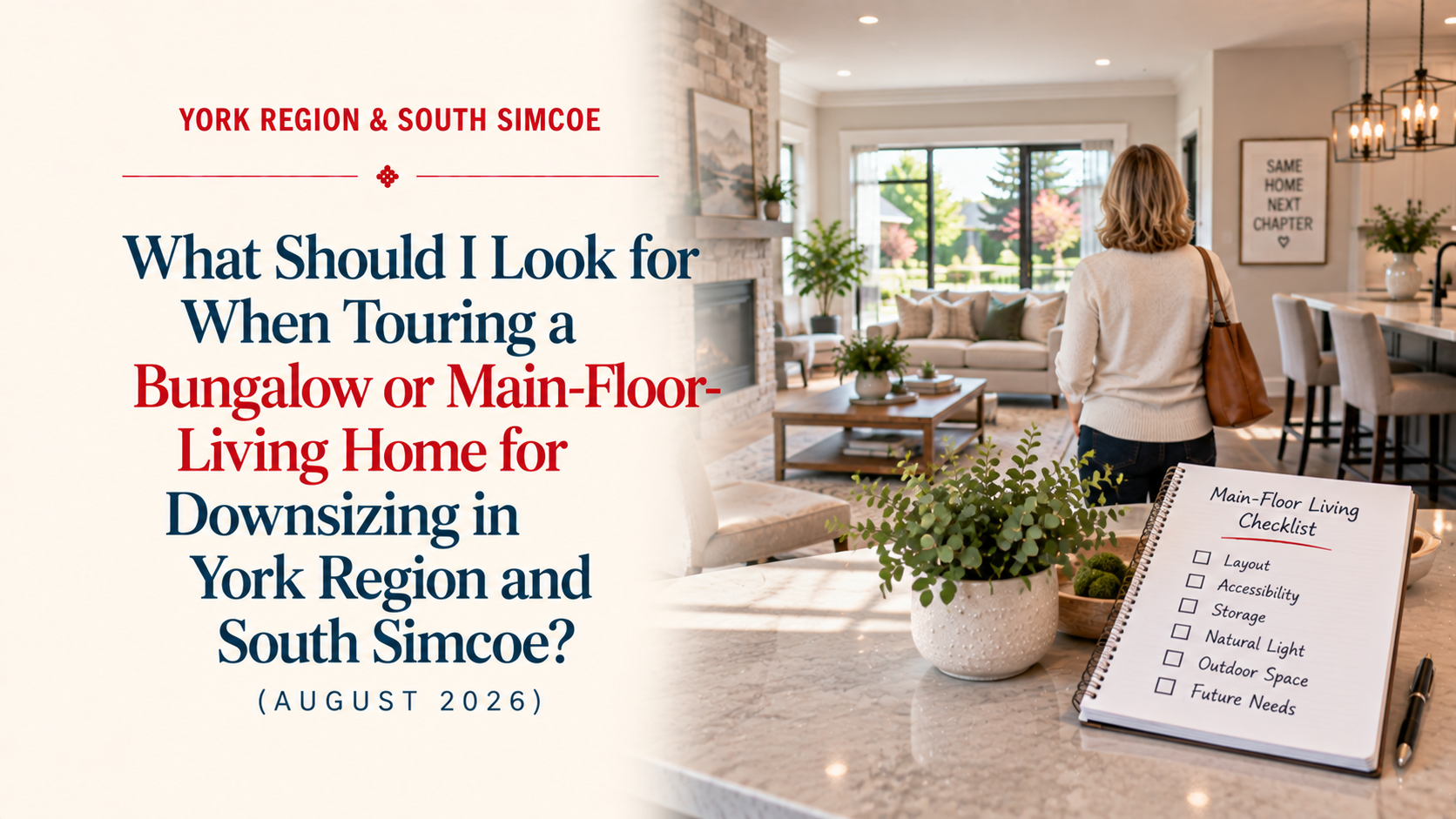
What Should I Look for When Touring a Bungalow or Main-Floor-Living Home for Downsizing in York Region and South Simcoe?
Short answer: when touring a bungalow or main-floor-living home for downsizing, test the routine you expect to live—not the property as if you were conducting an inspection. Notice how you arrive, move through the rooms, handle daily tasks, use storage, manage laundry and access the exterior. Then record the questions that need confirmation from the appropriate professionals.
A bungalow can reduce stairs between the rooms you use every day, but the label does not tell you whether the home will feel easier to manage. A main-floor-living home may still have a basement, a long driveway, exterior responsibilities, limited storage or a layout that does not fit your ordinary week.
How should a downsizer tour a bungalow or main-floor-living home?
Use three separate lenses during the tour. First, test the lifestyle and routine: how the home feels to enter, move through and use on an ordinary day. Second, record listing, ownership and document questions that need confirmation. Third, separate technical, safety, condition, construction, inspection, insurance, financing, legal or accessibility questions for the appropriate qualified professionals. This keeps a useful showing observation from being mistaken for a professional assessment.
What should I notice before I even enter the home?
- Where do you park, and how far is the route from the car to the entrance?
- Are the walkway, steps, threshold, door and lighting easy for your normal arrival routine?
- Where would deliveries, recycling, garbage, snow equipment, visitors and outdoor items be handled?
- Does the lot, driveway or exterior create work that the smaller floor plan does not show?
These are observation prompts, not a property inspection or accessibility assessment. A qualified inspector or other appropriate professional should address technical, safety, building-condition or accessibility questions for the specific property.
Which everyday rooms should I walk through slowly?
| Area | What to observe | What to confirm |
|---|---|---|
| Entry and circulation | Walk the route you would use with groceries, a coat, parcels or visitors. | Ask the appropriate professional about any technical, safety or accessibility concern. |
| Kitchen | Notice the distance between storage, preparation space, appliances and the eating area. | Confirm the condition and operation of features through the proper property-review process. |
| Bathroom | Consider privacy, storage, daily use and the route from the bedroom area. | Record questions about layout, fixtures or future changes for the appropriate professional. |
| Laundry | Notice where laundry is located and how the route fits your ordinary week. | Confirm the actual location, equipment, ventilation and property-specific responsibilities. |
| Storage | Think about seasonal items, tools, hobbies, documents, luggage and family visits. | Confirm what space is included, exclusive-use, shared or subject to a condominium rule. |
How do I test whether the layout fits my routine?
Use an ordinary weekday as your test. Imagine making breakfast, carrying laundry, bringing in groceries, answering the door, preparing for a visitor, taking out recycling and returning from an appointment. If you have hobbies, pets, family visits or outdoor routines that matter, include them in the walk-through.
- Start at the parking or arrival point.
- Walk to the entrance and through the rooms you would use most.
- Notice the transitions between living, sleeping, bathing, kitchen, laundry and storage areas.
- Write down what feels simpler and what creates a new question.
- Separate an observation from a technical, legal, financial, inspection or accessibility question that needs qualified advice.
Does main-floor living always mean lower maintenance?
No. Main-floor living describes how the rooms are arranged, not who maintains the roof, windows, driveway, yard, snow, exterior, mechanical systems or common areas. Compare the actual property responsibilities, ownership structure and documents before assuming that a bungalow or main-floor-living home will reduce the work of the week. A property-specific review is necessary because responsibilities can differ between freehold, condominium and common-elements arrangements.
What should I bring to a bungalow or main-floor-living tour?
- A short list of the rooms, routines and storage needs you want to preserve.
- A note of the questions that arise as you walk through the home.
- A simple comparison sheet so you can compare properties consistently rather than relying on first impressions.
- The contact information for the professionals you may need to consult about legal, inspection, insurance, financial or accessibility questions.
How does community fit into the decision?
A home can fit the floor-plan test and still create a difficult week if the location does not fit your routine. After touring the property, consider the errands, people, activities and places that matter to you. The YRSS Communities hub can help you organize the community questions to investigate; current property availability and suitability still need to be confirmed for the specific home.
The availability and current market context for bungalows and other main-floor-living options can change by community, property type, price range, condition and reporting period. Use the York Region and South Simcoe Market Reports hub to find dated information relevant to the areas and home types you are comparing. Market information is context for planning, not a valuation, forecast or guarantee.
What should I compare after touring two bungalows?
| Compare after each tour | Record |
|---|---|
| Arrival route | Parking, distance to the door, steps, route in poor weather and visitor access. |
| Everyday rooms | Main-floor kitchen, bathroom, bedroom, laundry, storage and main living space. |
| Lower level | What is stored or serviced below and how often it would need to be accessed. |
| Exterior | Lot, driveway, roof, yard, snow, garage and exterior spaces. |
| Ownership and documents | Freehold, condominium or common-elements arrangement, fees, rules, inclusions and responsibilities. |
| Location routine | Travel to people, errands, activities, parking and desired community connections. |
| Questions to confirm | Listing facts, documents, inspection, insurance, legal, financing, renovation, accessibility or other professional questions. |
Frequently asked questions
Is a bungalow a good choice for downsizing?
A bungalow may suit a downsizer who values main-floor access to everyday rooms, but it is not automatically easier or lower maintenance. Compare the specific layout, storage, basement dependence, exterior responsibilities, ownership structure, location and cost before deciding whether it fits your routine.
Should I compare a bungalow with a condominium when downsizing?
Yes. A bungalow and a condominium can address different priorities. A bungalow may change the daily room layout while leaving the owner responsible for the property itself. A condominium may organize certain shared-property responsibilities differently but can involve fees, rules, documents and unit-owner obligations. Compare the specific property, ownership structure, location, storage, outdoor space and responsibilities rather than assuming either is automatically easier. The related article Can I Downsize Without Moving Into a Condo? explores that decision in more detail.
Does a bungalow mean low maintenance?
No. A bungalow may simplify the route between everyday rooms, but roof, windows, driveway, yard, snow, exterior, mechanical systems and shared-area responsibilities still need to be understood for the specific home. For a broader discussion of responsibilities, see What Does Low Maintenance Really Mean When Downsizing?
Can I tell whether a bungalow will work for me from one tour?
A first tour can help you identify what fits your routine and what needs further confirmation, but it cannot answer every property-specific question. Record what you observe, compare it with other homes and direct condition, document, legal, insurance, financing, inspection, construction and accessibility questions to the appropriate professionals.
What should I compare between two bungalows?
Compare the route from parking to the entrance, the rooms used every day, stairs and lower-level needs, storage, laundry, exterior work, ownership responsibilities, location routine and the questions that require documentation or professional confirmation. Use the same comparison sheet for both homes so that the decision is not based only on first impressions.
Is this checklist a substitute for a home inspection?
No. It is an observation and comparison tool for a property tour. It does not assess the condition, safety, accessibility, construction, systems or value of a home. Direct those questions to the appropriate qualified professionals.
What if a home works on the main floor but has important storage or systems downstairs?
That is a useful distinction to record. Main-floor living may reduce the need to use stairs for daily rooms without removing the need to access storage, laundry, mechanical areas or other parts of the home. Compare the actual routine rather than the label.
What should I do if the tour raises a question I cannot answer?
Write the question down, identify which professional or document can answer it and avoid turning an assumption into a decision. Pam can help organize the property, location and comparison questions; regulated or technical questions belong with the client’s chosen qualified professionals.
This Q&A supports the Downsize, Right-Size, or Age in Place decision path. You can also use the Downsizer Decision Kit or book a 15-Minute Right-Sizing Conversation to organize the questions that need to be answered before comparing specific homes.
Review status: The original draft has received one independent completeness review. This corrected version incorporates the review recommendations and requires Pam’s approval before publication.
Scope note: This page provides real estate decision guidance and observation prompts. It is not legal, financial, tax, insurance, inspection, construction or accessibility advice. Confirm the specific property and related questions directly with the appropriate qualified professionals.